
A yacht charter for 20 people is a cabin problem before it is a party problem. The group is usually somewhere between 15 and 30: a family reunion, a milestone birthday, a board off-site, or friends who want a week afloat rather than a hotel buy-out. They ask for one yacht. Most of the crewed fleet is not offered that way. The overnight number on a normal charter yacht stops at 12, and a group of 20 does not become 12 by wishing.
This note is the practical version of that constraint. It covers four things a group of this size can actually do. One is a yacht whose own page lists more than 12 overnight guests. One is two or more yachts on the same itinerary, sometimes called a buddy charter or a flotilla. One is a yacht that lists more day guests than overnight guests, where the certificate allows it, with the rest of the group in a house ashore. One is splitting the group by cabins so that "20 people" and "20 cabins" are not treated as the same request. The prices below are the from-prices published on those yacht pages on 10 November 2026. A per-person figure appears only as arithmetic from a listed base fee. It is not a fare the yacht sells.
A dock party, a product launch or a wedding ceremony is a different page. Those briefs live on corporate yacht charter, celebration yacht charter and yacht wedding. This page does not replace them. It answers the overnight question they are often asked to stretch.
Why most charter yachts sleep 12
The number 12 is a regulatory line, not a preference for round tables.
The International Maritime Organization, on its page of ship-type definitions, states that a passenger ship is a ship which carries more than twelve passengers, and it cites SOLAS Chapter I Regulation 2 for that sentence. A passenger, in the same regulation, is every person other than the master and the crew, or other persons employed on the business of the ship, and other than a child under one year of age. Cross that line and the ship is, in SOLAS terms, a passenger ship. The safety rules that follow are the passenger-ship rules, which were written for ships that carry the public, not for a private charter with a chef.
The Red Ensign Group wrote a yacht code so that a commercial yacht does not have to meet every passenger-ship rule in full, within a defined limit. The July 2024 edition of the REG Yacht Code is in two parts, and the preamble of each part states the scope in the same words. Part A applies to yachts which are 24 metres and over in load line length, are in commercial use for sport or pleasure, do not carry cargo and do not carry more than 12 passengers. Part B applies to pleasure yachts of any size, in private use or engaged in trade, which carry more than 12 but not more than 36 passengers and which do not carry cargo. Part B also says it applies to pleasure yachts on international voyages carrying more than 12 but not more than 36 passengers, with a maximum number of persons not more than 200, and which do not carry cargo.
The UK Maritime and Coastguard Agency restates the Part A limit in MSN 1895, published 11 April 2025. The notice says Part A applies to yachts constructed on or after 1 January 2019 that are over 24 metres, operate commercially and carry no more than 12 passengers. It then says, plainly, that yachts which carry more than 12 passengers are not covered by that notice, and that the relevant standards are in Part B of the REG Yacht Code. The MCA notice is about UK ships and the dates in that notice. It is not a claim that every yacht in the Mediterranean or the Caribbean is Red Ensign flagged, or that a yacht built before 2019 is suddenly recertified by a 2025 notice.
What follows for a charter client is narrower than a law lecture. If a yacht is offered under a commercial code of this family, the overnight guest list is usually capped at 12 because that is the Part A yacht. A yacht offered for 13 to 36 passengers is a different certificate, the Part B shape, and there are fewer of them. A flag that is not a Red Ensign flag can use its own code. Turkish gulets, Croatian passenger vessels and some expedition hulls are listed with overnight counts above 12 because their certificates say so, not because the SOLAS sentence was waived in a brochure. If a page does not state the certificate, this guide does not guess it. The overnight number the yacht is offered for is the number on its page.
Crew are not passengers. A yacht with 12 guests and 11 crew is not a yacht for 23 guests. Children under one, on the SOLAS definition, are not counted as passengers either. Neither exception is a way to squeeze a twentieth adult into a 12-guest yacht.
Yachts that list more than 12 overnight guests
These are published listings, checked against the live page, not a claim that each one holds a Red Ensign Part B certificate. The guest count is the count the page states.
OLIMP is a 52-metre motor yacht offered in Croatia for 20 guests in 10 cabins, from €125,000 a week. Twenty guests in ten cabins means the listing is already counting more than one guest in a cabin. A group of 20 who each want a room of their own is not the group this page is describing. A group of 20 who will share, as couples or as pairs of friends, is the group the cabin count fits.
KASSANDRA is a 48-metre motor yacht offered in Greece for 14 guests in 7 cabins, from €140,000 a week. Fourteen is enough for a group that is "about 15" only if a few people are happy to be the ones who do not sleep aboard, or if the group is actually 14. It is the wrong boat to promise to 20.
GRAND OCEAN is an 85-metre motor yacht offered in the Leeward Islands for 24 guests in 14 cabins, from €800,000 a week. That is a Caribbean answer for a group that wants one hull and is ready for a base fee in that range. Twenty-four guests in fourteen cabins is, again, a shared-cabin count, not fourteen people plus ten pull-out beds invented for this article. The page's cabin count is 14. The page's guest count is 24.
Dividing a base fee by the guest count is a way to read the listing. It is not a price per head. OLIMP's €125,000 divided by the 20 listed guests is €6,250 of the base fee for each listed guest, for the week, before APA and before VAT. Nobody invoices that number. It is useful only when someone in the group asks "what is my share of the boat" and needs to see that the yacht is chartered whole.
The superyacht charter page is the right next read when the brief has moved into this size of hull. The Greece and Croatia hubs are the coasts those first two listings sit on. Turkey is the gulet coast: a traditional wooden hull is often how a larger cabin count is offered in that cruising area, and the overnight number is still the one on the particular yacht, not a national average.
Two yachts, one itinerary
When no single yacht on the dates lists 20 overnight guests, the workable plan is two yachts. Each yacht keeps its own contract, its own crew and its own base fee. The group shares the anchorages, the lunch stop and the evening plan. The usual names for this are a buddy charter and a flotilla. It is not a discount. It is two charters that agree to travel together.
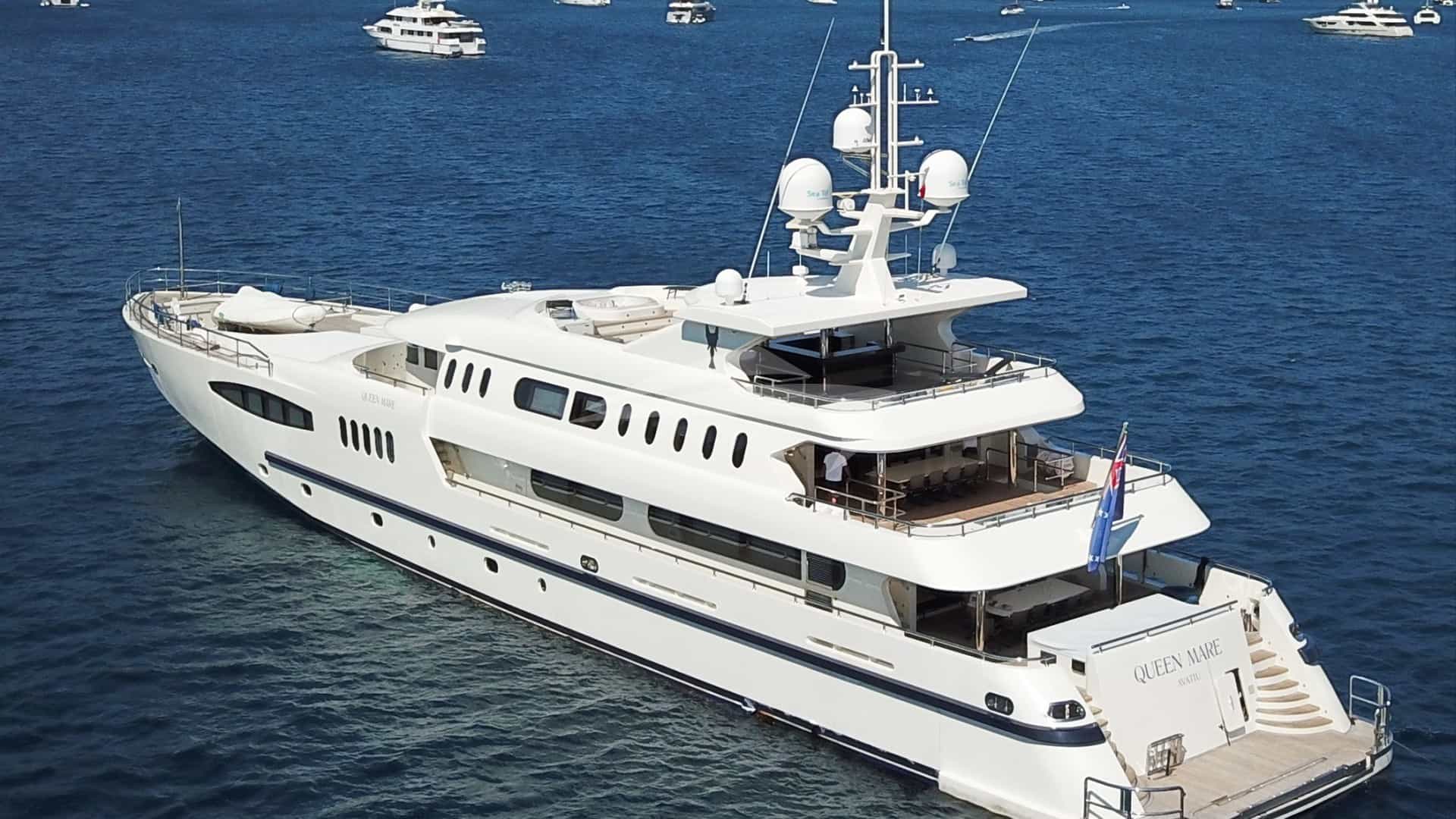
Two Greece listings that each stop at 12 make the arithmetic obvious. QUEEN MARE is a 58-metre motor yacht for 12 guests in 6 cabins, from €200,000 a week. ITOTO is a 61-metre motor yacht for 12 guests in 8 cabins, also in Greece, also from €200,000 a week. Together they list 24 overnight guests. A group of 20 can split across them, with a few cabins left spare. The two base fees add to €400,000 before APA and before VAT. Dividing that combined base by 20 guests is €20,000 of base fee per person for the week. That division is a reading aid. The invoices remain two yacht charters.
The same shape exists in winter. SOUNDWAVE is a 63-metre motor yacht in the Leeward Islands for 12 guests in 6 cabins, from $550,000 a week. One SOUNDWAVE does not sleep 20. A second 12-guest yacht, free in the same islands in the same week, is what turns it into a buddy charter. The second fee is whatever that second page lists. This guide does not add a yacht that has not been named.
Splitting the group is a social decision as much as a naval one. Put the household that goes to bed early on one yacht and the household that sits up on the other. Put children with the cabins that fit them, not with the yacht that has the larger deck. The boats meet for lunch and for the swim. They do not have to share a galley. The family yacht charter page is the brief when the split is about ages rather than about a party. The celebration yacht charter page is the brief when the week is a birthday and the two boats are there so the group can stay together after dinner.
A pair of smaller catamarans is the same idea at a different size. The Greece catamaran guide, catamaran charter in Greece, is the route note for that hull. It does not raise the passenger limit. Two catamarans still means two certificates.
Day guests, and a house ashore
Some pages publish three guest numbers, and they are not interchangeable.
QUEEN MARE lists 12 sleeping guests, 12 cruising guests and 30 entertaining guests. ST DAVID, a 60-metre motor yacht in the Leeward Islands from $325,000 a week, lists 12 sleeping guests, 12 cruising guests and 200 entertaining guests, in 6 cabins. Sleeping is who has a cabin for the night. Cruising is who the page lists for a passage. Entertaining is a third field. On these two yachts the cruising number matches the sleeping number: 12. The entertaining number is higher. That does not, by itself, mean 30 people on QUEEN MARE or 200 people on ST DAVID can remain aboard once the lines are slipped. Who may be carried at sea is the certificate. A reception at the dock, with guests who leave before the yacht sails, is a different operation and is priced as an event. That is the corporate yacht charter conversation.
Where the certificate really does allow more people by day than by night, the rest of a group of 20 sleep ashore. The yacht is the daytime boat. The house is the bedroom. In Mallorca that house is the estates brief, on Mallorca estates, not a cabin the yacht does not have. The yacht still has to be the right yacht for the day, with a tender plan that matches the house. This guide does not invent a day rate for that combination. A day is priced from the yacht that is actually free, and the house is priced on its own page.
A group that tries to use the entertaining number as the overnight number will be stopped at the manifest. Write the sleeping list and the day list as two lists, before anyone books a flight.
How the money actually works
A yacht charter for 20 people is priced per yacht. The base fee covers the yacht and the crew for the week, on the terms of that contract. It does not become cheaper because the group is large, and it does not become a rate per head because someone divided it.
Three lines sit on top of the base. They are explained in full in the yacht charter cost and APA guide and in hidden costs of a yacht charter. The short version, using only rates this site already publishes, is this.
APA, the advance provisioning allowance, is the float for fuel, food, berths and the other costs that move with the route. The Greece yacht charter hub says to plan APA at about 25–35% of the base rate. Unspent money comes back. A shortfall is settled. The percentage on a contract can differ. The band is a planning tool.
VAT, or the local charter tax, follows the embarkation. The Greece hub states a working rate of 12% on a crewed charter of more than 48 hours, and notes that the rate can be lower depending on the yacht's licence. The Croatia hub states a working rate of 13%. Both hubs treat the figure as a planning rate. The agreement states the rate for that yacht. A Caribbean week does not inherit either of those rates. The Caribbean hub, the British Virgin Islands page and the Bahamas page are where that coast is planned, and the tax line is the one in the contract for the island the week starts from. This page does not copy a Caribbean percentage into a Greek example.
Crew gratuity is discretionary. The cost guide treats 10–15% of the base fee as the customary range, paid to the crew at the end of the week. It is not a tax. On two yachts it is two crews.
An illustration, using OLIMP's published base of €125,000 and the Croatia hub's working VAT, plus the APA band the Greece hub publishes as a planning range:
- Base charter fee: €125,000
- APA at 30%, the middle of the 25–35% band: €37,500, reconciled against receipts
- Croatian VAT at the hub's working rate of 13% on the base: €16,250, if that is the treatment on the contract
- Gratuity at 10% of the base: €12,500. At 15%: €18,750
Add the base, a 30% APA, 13% VAT and a 10% gratuity and the planning total is €191,250. Swap the gratuity to 15% and it is €197,500. Change the APA to 25% and both totals fall by €6,250. This is arithmetic on published figures. It becomes a price only when the contract names OLIMP, the week and the tax line. KASSANDRA, at €140,000 in Greece, would use the Greek working rate of 12% if the contract does, which is €16,800 on that base, not the Croatian 13%.
The two-yacht Greece illustration works the same way, on two bases. QUEEN MARE at €200,000 plus ITOTO at €200,000 is €400,000 of base fees. APA at 30% of that combined base is €120,000. Greek VAT at the hub's working 12%, if both charters embark in Greece and both contracts use that rate, is €48,000. Gratuity at 10% of the combined base is €40,000, and at 15% it is €60,000. Those percentages are applied in the illustration to the sum only to show scale. In the paperwork they are applied to each yacht. A euro left over in one APA is not automatically spent on the other yacht.
Nothing in these illustrations includes flights, the villa, or a dock event. Those are separate invoices. Plan the charter when the dates exist, or contact Blue Ocean Club if the group is still choosing the coast.
Mediterranean or Caribbean
The Mediterranean is where the smaller from-prices for a true overnight group currently sit. OLIMP at €125,000 for 20 guests in Croatia, and KASSANDRA at €140,000 for 14 guests in Greece, are the listings a group of about 20 should read before assuming a superyacht is required. A Greece week that is really two 12-guest yachts, QUEEN MARE and ITOTO, is €400,000 of base fees and a great deal more boat than OLIMP. The right choice is the one whose cabin plan fits the people, not the one with the lower euro figure.
The Caribbean is a winter coast, and the listings above are priced like it. GRAND OCEAN's 24 guests start at €800,000 a week in the Leeward Islands. SOUNDWAVE's 12 guests start at $550,000 a week, so a pair is two fees in that currency, not a conversion invented here. ST DAVID's 12 sleeping guests start at $325,000 a week, with an entertaining figure that has to be read against the cruising figure of 12. The private yacht charter Mediterranean page and the Caribbean hub are the maps. They are not interchangeable weeks. A July group that cannot travel in January does not get a Caribbean price by asking. A January group does not get OLIMP's Croatia rate in the Leeward Islands.
Turkey sits beside Greece for groups who want a gulet. The cabin count and the from-price are on the gulet's own page. This guide does not supply a typical gulet guest number, because the listings differ and a typical number would be a guess.
How far ahead, and what to send
The how to book a yacht charter guide on this site is the timing note. Peak weeks, July to mid-August in the Mediterranean and Christmas and New Year in the Caribbean, are booked 9 to 12 months ahead. Shoulder weeks in May, June and late September can often be confirmed 2 to 4 months out. A yacht that sleeps more than 12, or two specific 12-guest yachts that both have to be free, is a thinner set than "any 40-metre yacht". The peak window is the one to use when the date is a birthday or a public holiday. Waiting for a last-minute pair is how a group of 20 ends up in a hotel.
Send five facts, not a mood board. How many people sleep aboard, and how many are day guests only. Whether anyone needs a cabin to themselves. The coast and the week. Whether the group can split across two yachts. The airport everyone can actually reach. The reply can then be one yacht, two yachts, or a yacht plus a house, with the base fees taken from the pages rather than from a range.
Frequently asked questions
Can 20 people sleep on one charter yacht?
Only when that yacht's own page lists 20 or more overnight guests. Most crewed charter yachts are offered for no more than 12 passengers, which is the line in SOLAS for a passenger ship and the line in Part A of the Red Ensign Group Yacht Code. In the current Blue Ocean Club listings, OLIMP lists 20 guests in 10 cabins in Croatia from €125,000 a week, and GRAND OCEAN lists 24 guests in 14 cabins in the Leeward Islands from €800,000 a week. The figure on the yacht page is the one that applies.
Why do most yacht charters stop at 12 overnight guests?
The International Maritime Organization's summary of SOLAS Chapter I Regulation 2 defines a passenger ship as a ship which carries more than twelve passengers. Part A of the Red Ensign Group Yacht Code, July 2024 edition, applies to yachts of 24 metres and over in load line length, in commercial use for sport or pleasure, that do not carry cargo and do not carry more than 12 passengers. UK MSN 1895, published 11 April 2025, says the same for Part A and points yachts that carry more than 12 passengers to Part B. A different flag can use a different code. The yacht page, not a general rule of thumb, is the overnight number for that hull.
What is a buddy or flotilla charter for a large group?
Two or more yachts, each on its own contract, sailing the same itinerary so the group can eat together and still sleep in legal cabins. QUEEN MARE and ITOTO each list 12 guests in Greece from €200,000 a week. Booked together, the two base fees are €400,000 before APA and before VAT. That is two yachts and two crews, not one merged fare. In the Leeward Islands, SOUNDWAVE lists 12 guests in 6 cabins from $550,000 a week and can be one half of the same kind of pair.
Can a yacht take more people by day than it sleeps?
Sometimes the page lists three different numbers. QUEEN MARE, a 58-metre motor yacht in Greece from €200,000 a week, lists 12 sleeping guests, 12 cruising guests and 30 entertaining guests, in 6 cabins. ST DAVID, a 60-metre motor yacht in the Leeward Islands from $325,000 a week, lists 12 sleeping guests, 12 cruising guests and 200 entertaining guests, in 6 cabins. The entertaining figure is not permission to sleep that many people, and it is not permission to carry them at sea. The flag and the certificate decide who may be aboard underway. A dock event is a different brief, and it belongs on the corporate yacht charter page.
How much does a yacht charter for 20 people cost?
The price is the base fee of each yacht, then APA, then the tax for the embarkation, then a discretionary crew gratuity. It is not a per-person fare. OLIMP lists from €125,000 a week for 20 guests. Dividing that base by 20 is €6,250 of the base fee per listed guest, before APA and before VAT. The Greece hub uses about 25–35% of the base as the APA planning band, and a working Greek VAT rate of 12% on a crewed charter of more than 48 hours. The Croatia hub uses a working VAT rate of 13%. The charter agreement states the rate for that yacht. The cost and APA guide explains the lines.
Where does a group of 20 work best, the Mediterranean or the Caribbean?
Both, on different boats. Croatia and Greece currently list yachts offered for more than 12 overnight guests, including OLIMP and KASSANDRA. The Leeward Islands listing for GRAND OCEAN is 24 guests from €800,000 a week. A winter week of two 12-guest yachts is the Caribbean shape, and the British Virgin Islands and the Bahamas are the hubs for that coast. Turkey is the gulet coast when the group wants a traditional wooden hull with the cabin count that yacht actually lists. None of these is a substitute for reading the yacht page.
How far ahead should a group of 20 book?
The booking guide on this site says peak weeks — July to mid-August in the Mediterranean, Christmas and New Year in the Caribbean — are booked 9 to 12 months ahead, and that shoulder weeks in May, June and late September can often be confirmed 2 to 4 months out. A group of 20 is choosing from fewer hulls, or from two hulls that both have to be free. Use the peak window when the dates are fixed. Send the dates, the headcount and whether everyone sleeps aboard through the charter request page.
Sources
The regulatory sentences in this guide are taken from the documents below. Yacht prices, lengths, guest counts and cabin counts are taken from the live Blue Ocean Club pages linked in the text. VAT and APA bands used in the illustrations are the working rates already stated on the Greece and Croatia destination hubs, and the gratuity range is the one in the cost guide linked above.
- International Maritime Organization, "Safety regulations for different types of ships": a passenger ship is a ship which carries more than twelve passengers (SOLAS Chapter I Regulation 2). https://www.imo.org/en/ourwork/safety/pages/regulationsdefault.aspx
- Red Ensign Group Yacht Code, July 2024 edition, Part A: yachts of 24 metres and over in load line length, in commercial use for sport or pleasure, that do not carry cargo and do not carry more than 12 passengers. https://www.redensigngroup.org/media/yzlbtkyi/reg-yc-july-2024-edition-part-a.pdf
- Red Ensign Group Yacht Code, July 2024 edition, Part B: pleasure yachts which carry more than 12 but not more than 36 passengers and which do not carry cargo. https://www.redensigngroup.org/media/vbgpzms1/reg-yc-july-2024-edition-part-b.pdf
- UK Maritime and Coastguard Agency, MSN 1895 (M), published 11 April 2025: Part A covers commercially operated yachts over 24 metres that carry no more than 12 passengers; yachts which carry more than 12 passengers are referred to Part B. https://www.gov.uk/government/publications/msn-1895-m-the-red-ensign-group-reg-yacht-code-part-a/msn-1895-m-the-red-ensign-group-reg-yacht-code-part-a