
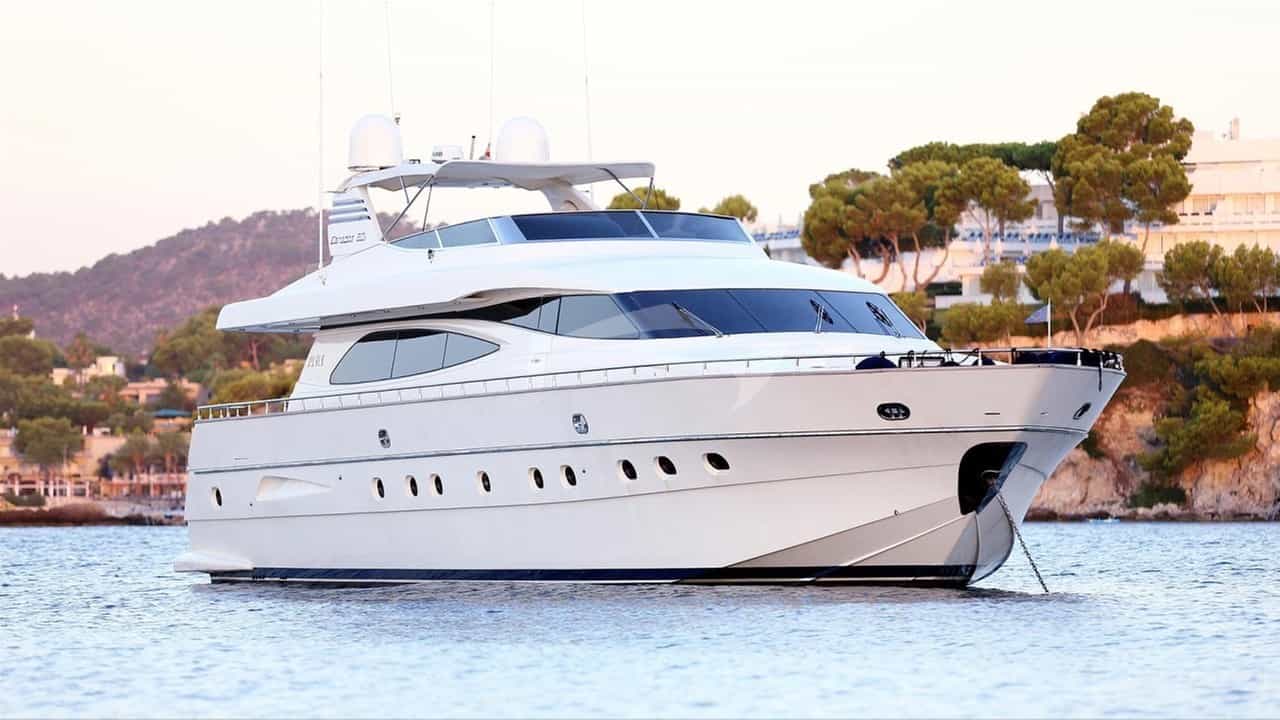
Mallorca makes chartering look easy. Palma's marinas sit about a quarter of an hour from the airport, and the island offers two coastlines in one week: the steep Serra de Tramuntana in the north-west and the shallow calas of the south and east. It also has more rules on the water than first-time visitors expect — about who may take the helm, where you may anchor and which islands need a permit.
That is why so many Mallorca weeks are booked with a professional at the helm. This guide explains what a skippered yacht charter in Mallorca includes, what the Spanish licence rules and the Balearic anchoring rules mean in practice, what the week costs beyond the base rate, and the point at which a small crewed yacht is simply the better choice.
What "skippered" means in Mallorca
A skippered charter is a boat that could otherwise be rented bareboat — usually a sailing monohull, a catamaran or a smaller motor yacht — with one professional skipper who runs it. The skipper is in command: passage planning, weather decisions, anchoring, berthing in busy marinas and the safety of everyone on board. Nobody in your group needs a licence, because the skipper's qualification is the one that covers the boat and the distance from the coast.
What a skipper does not normally provide is service. On a standard skippered week your group still shops, cooks or eats ashore, and keeps the cabins tidy.
A crewed yacht is a different product. The yacht comes with its own permanent crew — a captain and, depending on size, a chef, stewardess and deckhand — and the service is part of the week: provisioning against your preferences, cooked meals, cabin service, tender runs and water toys. On Mallorca the line between the two is unusually thin, because the island has a deep fleet of 25–30 metre motor yachts that sail with three to five crew. Our guide to what's included in a crewed yacht charter shows how a crewed day works.
Why a skipper makes sense in Mallorca
The licence ladder is precise. Spain sets out its recreational boating titles in Royal Decree 875/2014, and each one has a size and distance limit. Adults can take a small boat without any title — motorboats up to 5 metres with no more than 15 CV (11.26 kW), or sailing boats up to 6 metres — but only in daylight and within 2 nautical miles of the port, marina or beach they left from. The licencia de navegación raises that to 6 metres, still by day and within 2 miles of shelter. The Patrón de Navegación Básica covers motorboats up to 8 metres within 5 miles. The Patrón de Embarcaciones de Recreo (PER) is the first title that covers motorboats up to 15 metres within 12 miles of the coast and, importantly for a Balearic week, navigation between the islands. Even the highest recreational titles stop at 24 metres.
Foreign certificates work — within their limits. For the hire of Spanish-flagged pleasure boats, Spain lists accepted foreign certificates in Annex IX of the same decree. The UK's Royal Yachting Association reports that, since July 2021, this includes the RYA Day Skipper for boats up to 24 metres within 12 miles of the coast, and Coastal Skipper within 20 miles. That is more generous than Greece, where daylight-only certificates are often refused; our guides to renting a boat in Greece and in Croatia with a skipper cover those rules. But it still means somebody in your group has to hold the right paper for the right boat, and has to want to spend the week working.
Anchoring is regulated. Large areas of the Balearic seabed are meadows of Posidonia oceanica, a protected seagrass. Under the Balearic Government's Decree 25/2018, anchoring on Posidonia is prohibited as a general rule; boats may only use authorised low-impact moorings over it, and the anchor chain must not drag across nearby meadows. In practice that means finding sand patches in crowded calas, or a buoy field, every single day. A skipper who knows where the sand is in Es Trenc or off Cala Llombards saves the group a lot of circling.
Cabrera needs paperwork before you go. The Cabrera Archipelago, south of Mallorca, is a national park. A private or chartered boat needs a navigation authorisation before entering the park, and a separate mooring authorisation to stay overnight on one of the harbour buoys; landing ashore is by tender at the designated quays only. The park's own information says that boats up to 15 metres with a navigation authorisation can use day buoys between one hour after sunrise and one hour before sunset. Ask early who will request the permits.
You want to stop working. With a skipper, the forecast, the anchor and the berthing are someone else's job.
What Spanish rules and taxes mean for you
Three points explain most of the cost lines and practical rules you will see.
VAT is its own line. Blue Ocean Club's Mallorca yacht charter hub notes that Spain commonly applies 21% VAT on a qualifying charter in Spanish waters, and that a Palma offer should show the base fee, the APA and Spanish VAT on separate lines. The hub also points out that the yacht has to be able to charter legally from the island — a point confirmed in the agreement, not assumed from a brochure rate.
Port taxes often hide inside berthing fees. The RYA explains that Spain's T-0 (aids to navigation) and T-5 (use of harbour waters and facilities) port taxes are often collected together with berthing fees, though regional practice varies. If your skippered boat spends nights in marinas rather than at anchor, ask whether the quoted berth includes them.
There is no discharge near the coast. The RYA summarises Spanish guidance as no untreated sewage discharge within territorial waters (12 nautical miles), and none at all in port waters, protected areas, estuaries and bays. Holding-tank pump-outs become part of the route plan.
What a skippered week costs beyond the base rate
The base rate on a skippered boat covers the boat. Most other things are extra, and they behave differently from the cost lines on a crewed yacht. Before you book, ask about:
1. The skipper's fee, usually quoted per day and set by boat size and season. Get it in writing. 2. The skipper's cabin. The skipper sleeps on board, so one cabin (or a crew cabin on some catamarans) is not available to your group. 3. The skipper's meals, aboard or ashore, and whether the group is expected to cover them. 4. Running costs: fuel, marina nights (with any T-0/T-5 port taxes), water and electricity, and end-of-charter cleaning. 5. Permits: Cabrera authorisations are requested from the park, and any buoy fields you plan to use. 6. Provisioning and restaurants for everyone aboard, plus a tip for the skipper at your discretion.
A crewed yacht has a cleaner structure: a weekly base rate, an Advance Provisioning Allowance (APA) that pays for fuel, food, drink and berths at cost, VAT, and a gratuity for the crew. For a Mallorca week of east-coast calas and one night in Puerto Portals, our hub plans APA at around 25–35% of the base rate, and puts a 20-metre crewed motor yacht at around €25,000–€40,000 a week before those lines. The yacht charter cost and APA guide, our Mallorca yacht charter cost breakdown and the piece on hidden costs of yacht charter explain each line.
Skippered boat or small crewed yacht: how to decide
A simple test: if the reason you want a skipper is that you don't want to work on holiday, you probably want a crew, not just a skipper.
| Skippered boat | Small crewed yacht | |
|---|---|---|
| Who runs the boat | One professional skipper | Captain plus crew (3–5 on the yachts listed below) |
| Food | You shop, cook or eat ashore | Crew provisions and serves; chef on larger yachts |
| Cabins and cleaning | You | Crew |
| Space | One cabin goes to the skipper | Separate crew quarters |
| Licence needed by guests | No | No |
| Typical boat | Sailing monohull, catamaran, smaller motor yacht | 25–35 m motor yacht or sailing yacht |
| Pricing logic | Base rate + skipper fee + extras | Base rate + APA + VAT + gratuity |
On Mallorca the gap between the two is often smaller than people expect. A few crewed yachts from Blue Ocean Club's live Balearic listings, with the specifications shown on each yacht page:
- JURIK — a 25.3-metre Canados motor yacht for 9 guests in 4 cabins with a crew of 3, listed for the Balearic Islands at €29,700 a week. For two families who would otherwise be weighing a skippered catamaran.
- FROGGY — a 25-metre Sunseeker for 8 guests in 4 cabins with a crew of 3, listed for the Balearic Islands and Spain at €28,800 a week for Winter 2026, with jet ski, paddleboards and towables aboard.
- CHAMPAGNE HIPPY — a 25.2-metre Oyster sailing yacht for 6 guests in 3 cabins with a crew of 3, listed for Summer 2027 in the Balearics and other western Mediterranean waters at €30,000–€34,000 a week. For a group that wants real sailing without handling a line.
- BELISA — a 33-metre Mangusta for 10 guests in 4 cabins with a crew of 5, listed for Summer 2027 in the Balearic Islands and Spain at €77,000–€96,250 a week.
- NAILU + — a 30.1-metre Ferretti launched in 2024, for 10 guests in 5 cabins with a crew of 5 and a Jacuzzi on deck, listed for Summer 2027 in the Balearic Islands and Spain at €110,000–€125,000 a week.
Rates are a starting comparison: availability, APA, VAT and the exact week decide the final figure. Each yacht above is longer than 24 metres, the ceiling of Spain's recreational titles, which is one reason boats of this size come with a professional crew. If you are weighing hull types, the crewed catamaran charter page and our bareboat vs crewed yacht charter comparison go further.
Where to go: three ways to shape a Mallorca week
From Palma: the south-east calas and Cabrera. Most Mallorca charters start in Palma, at Puerto Portals or at Port Adriano; our seasonal guide points yachts of 40 metres and more to Palma's larger berths, such as STP Palma. The classic first week heads east to Es Trenc and the Colònia de Sant Jordi anchorages, takes a Cabrera day when the permit and weather allow, then works up the east-coast calas before returning. It suits families and swimmers, and it is where Posidonia rules matter most, because the best water sits over seagrass.
North-west: the Tramuntana. A west-and-north week passes Port d'Andratx and runs along the Tramuntana cliffs. Blue Ocean Club's Mallorca hub calls Port de Sóller the only truly protected harbour on that coast, which is why this route depends on a settled forecast and someone who knows when to tuck in. It is the more dramatic week, with more time underway and fewer beaches.
Mallorca plus Ibiza or Menorca. A PER, a qualifying foreign certificate or a professional skipper is what makes an inter-island week possible. Our hub treats Ibiza and Menorca as their own weeks rather than day trips; if you want both islands, plan a one-way charter or a full Balearic Islands yacht charter, and read Mallorca vs Ibiza yacht charter first.
When to go. Our Mallorca seasonal guide puts the season from May to October, with the peak from mid-July to late August. June brings a steady afternoon sea breeze (the Embat) and manageable beaches; September keeps the sea warm with lighter winds and fewer boats. For a ready-made route, see the Mallorca classic highlights 7-day itinerary.
Booking tips
- Decide on service before boat type. "Who cooks?" settles more charters than "sail or motor?".
- Count berths after the skipper. Ask which cabin the skipper uses and whether the advertised guest number already allows for it.
- Get every extra in writing: skipper fee, meals, fuel, marina nights, port taxes, cleaning and deposit.
- Ask about Cabrera early. If a Cabrera day or night matters, ask who requests the authorisations and when.
- Check the VAT line and the yacht's ability to charter commercially from Mallorca; the contract, not the listing, is what binds.
- Book peak weeks early. Late July and August fill first; June and September are often the better weeks on the water.
If you are still deciding between formats, read our day charter yacht guide for single days from Palma, and the Balearic Islands yacht charter overview for the wider archipelago.
Plan your Mallorca week with Blue Ocean Club
Tell us your dates, group size, the coves that matter and how much you want to be looked after. We will shortlist skippered and crewed options that genuinely fit, and lay out every cost line — base rate, APA, VAT and extras — before you commit. Plan my charter or contact us.
FAQ
Do I need a boating licence for a skippered yacht charter in Mallorca? No. The professional skipper holds the qualification for the boat and the distance from the coast, so guests need no licence or sailing experience.
Can I rent a boat in Mallorca without any licence at all? Only a very small one. Spanish rules allow adults to take motorboats up to 5 metres with no more than 15 CV, or sailing boats up to 6 metres, in daylight and within 2 nautical miles of the departure point. Anything larger needs a licence, a qualifying certificate or a skipper.
Can we anchor anywhere in Mallorca? No. Balearic Decree 25/2018 prohibits anchoring on Posidonia seagrass as a general rule; boats anchor on sand or use authorised buoys.
Do we need a permit to visit Cabrera? Yes. Boats need a navigation authorisation from the national park to enter its waters, and a separate mooring authorisation to stay overnight on a harbour buoy.
What VAT applies to a yacht charter in Mallorca? Spain commonly applies 21% VAT on a qualifying charter in Spanish waters. It is shown as its own line, alongside the base rate and APA.
Sources
- Royal Decree 875/2014 of 10 October on nautical titles for pleasure craft (articles 8–11, consolidated text), Boletín Oficial del Estado: https://www.boe.es/buscar/act.php?id=BOE-A-2014-10344
- Royal Yachting Association, country-specific advice, Spain (Annex IX recognition of RYA certificates since Royal Decree 339/2021, T-0 and T-5 port taxes, sewage discharge): https://www.rya.org.uk/boating-abroad/country-specific-advice/spain/
- Government of the Balearic Islands, Decree 25/2018 of 27 July on the conservation of Posidonia oceanica, BOIB no. 93 of 28 July 2018 (articles 4 and 7): https://www.caib.es/eboibfront/pdf/es/2018/93/1014008
- Government of the Balearic Islands, Cabrera Maritime-Terrestrial National Park, navigation and mooring authorisations and day buoys: https://www.caib.es/sites/espaisnaturalsprotegits/es/parque_nacional_maritimoterrestre_del_archipielago_de_cabrera/ and the park reservation system: https://www.caib.es/rescabfront/?lang=es
- Blue Ocean Club Mallorca destination hub (VAT line, APA band, 20-metre weekly range, Port de Sóller), Mallorca seasonal guide (season, Embat), and the live yacht pages linked above (length, guests, cabins, crew, listed area and weekly rate).