
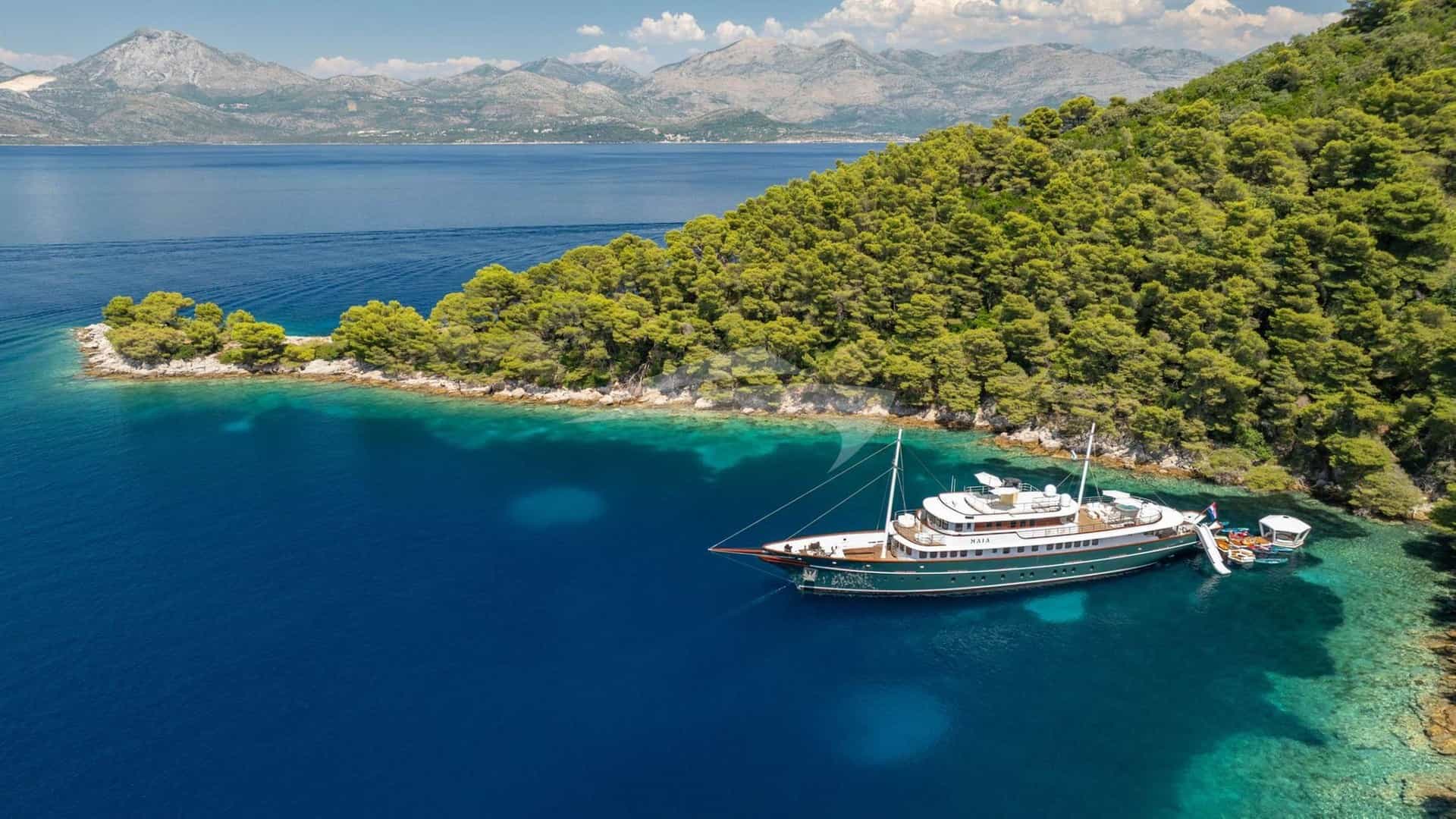
Cavtat occupies a commandingly strategic position on the wooded Rat peninsula, precisely 12 nautical miles south of Dubrovnik’s medieval fortress walls and three nautical miles from Dubrovnik Airport at Čilipi. Serving as the southernmost port of entry for Croatia, this historic town—built on the foundations of ancient Epidaurum—is both a refined maritime destination in its own right and the ideal spring-board for navigating the southern Dalmatian archipelago or crossing into Montenegro’s Bay of Kotor.
For the discerning guest, timing a Yacht Charter Cavtat yacht charter requires an understanding of the regional weather dynamics. The southern Adriatic climate is shaped by the dramatic topography of the Dinaric Alps, where limestone massifs rise sharply behind the coast. The interaction between landmass heat, sea temperatures, and seasonal pressure systems dictates everything from afternoon wind strength to underwater visibility in the surrounding island groups.
The Microclimate and Maritime Geography of Cavtat
Cavtat is defined by two horseshoe-shaped bays: Uvala Luka to the south-east and Uvala Tiha to the north-west, divided by the cypress-clad pine ridges of the Rat peninsula. Uvala Luka forms the main harbour, lined with a wide stone promenade where yachts up to 60 metres can berth stern-to directly alongside palm-shaded marble quays. The harbour offers excellent protection from the prevailing summer winds, though it remains exposed to strong north-westerly swells if a summer storm sweeps down the coast.
Directly seaward lie the uninhabited islets of Mrkan, Bobara, and Supetar. These low-lying limestone outcrops form a natural barrier against open sea swells from the south-west, creating a calm sound ideal for brief lunch stops or water-sports directly upon departure from the quay.
Understanding local wind mechanics is central to planning your daily itinerary:
- The Maestral: A reliable north-westerly thermal breeze that rises around 11:00, peaks between 14:00 and 16:00 at 12 to 18 knots, and dies completely by sunset. It is the summer sailor’s ally, keeping air temperatures comfortable and providing ideal conditions for sailing between Cavtat and the Elaphiti Islands.
- The Bura: A cold, dry, katabatic wind blowing from the north-east off the Dinaric mountain chain. While less frequent in mid-summer, a post-front Bura can gust violently down the Konavle valley through the mountain gaps behind Cavtat, creating short, steep seas and requiring secure anchoring with generous chain scope.
- The Jugo: A humid, warm south-easterly wind that originates in North Africa and gathers moisture across the Mediterranean. It brings overcast skies, rising atmospheric pressure, and long rolling swells. The Jugo builds slowly over several days, giving captains ample time to shift from open roadsteads into sheltered harbours like Šipanska Luka or the deep inlets of Mljet.
May: High-Clarity Waters and Early-Season Seamanship
May marks the awakening of the southern Dalmatian charter season. While the resort towns of the mainland are quiet, the natural environment is at its greenest. Snow melt from the inland ranges feeds coastal runoff, while wild herbs—sage, rosemary, and thyme—bloom across the slopes of the Rat peninsula, filling the air with aromatic oils carried on gentle sea breezes.
### Weather and Water Conditions Air temperatures in May range between 18°C and 22°C during the day, dropping to 13°C at night. Sea temperatures linger around 18°C, which most guests find invigorating rather than warm. Wetsuits are recommended for extended snorkeling or seabob sessions around the underwater caverns of Mrkan Islet. Rainfall is moderate, occurring in brief spring showers rather than prolonged fronts. High-pressure systems bring crisp, crystalline skies with extraordinary visibility, often allowing charter guests on deck to clearly see the mountains of Montenegro 30 nautical miles to the south-east.
### Cruising Realities and Routing The primary advantage of a May charter is absolute calm across the waterways. The passage north-west from Cavtat past Lokrum Island (8 nautical miles) to the Elaphiti Islands—Koločep, Lopud, and Šipan—is virtually empty of commercial traffic. You can anchor undisturbed in the turquoise waters of Šunj Bay on Lopud's southern tip, a location that becomes heavily congested by mid-summer.
Harbour berths along the Cavtat Riva are readily available without advance reservations, allowing captains to maintain flexible itineraries based on real-time weather rather than rigid berthing allocations. May is also the optimal period for guests wishing to secure extended bookings on top-tier motor yachts that operate with high seasonal demand later in the year.
June: Thermal Winds and the Prime Cruising Window
June is considered by experienced Adriatic captains to be the prime month for a Cavtat yacht charter. Daylight stretches past 20:30, providing long, sun-drenched afternoons at anchor. The summer heat has established itself without reaching the oppressive humidity of late July, and the sea has absorbed enough solar energy to make water sports consistently inviting.
### Weather and Sea Dynamics Daytime air temperatures average 25°C to 28°C, while sea temperatures climb rapidly to 22°C–24°C. The weather is dominated by stable high-pressure cells, establishing the classic Mediterranean daily wind pattern. The afternoon Maestral blows reliably across the Konavle Channel at 14 to 16 knots, creating flawless conditions for cruising under sail without generating significant ocean swell.
### Seasonal Highlights and Gastronomy In June, the seasonal konobas (traditional Dalmatian taverns) along the coast open fully. In Cavtat, dining directly on the waterfront reveals the region's culinary focus: fresh wild-caught sea bass, dentex, and langoustines brought in by local fishermen in the early hours.
A short tender ride across Uvala Luka brings guests to quayside tables where local dishes are served alongside Malvasija Dubrovačka, an ancient, aromatic white wine grape cultivated almost exclusively in the nearby Konavle valley. June also sees the start of early summer cultural recitals held in the courtyards of Cavtat’s Renaissance palaces, such as the Rector’s Palace (Knežev Dvor).
July and August: Peak Summer Realities and Tactical Routing
July and August represent the peak of the Mediterranean charter calendar. Cavtat transforms into a vibrant hub for international yachts, with mega yachts lining the outer breakwater and traditional gulets anchored across Uvala Tiha. The air is warm, the sea is tropical in temperature, and the atmosphere along the waterfront is electric.
### Managing Heat, Crowds, and Berthing Daytime temperatures frequently reach 32°C to 35°C, with night temperatures rarely dipping below 23°C. Full air-conditioning systems and high-capacity water-makers are essential operational requirements during these months. Sea temperatures reach 25°C to 27°C, transforming every bay into an ideal arena for swimming, foil-boarding, and diving.
The main challenge of peak summer is harbor density. Cavtat’s waterfront quay fills by 14:00 daily as yachts arriving from Montenegro or Dubrovnik seek customs clearance and overnight berths. Captains must adopt tactical routing:
- Customs Clearance Strategy: Cavtat is an official seasonal port of entry. During July and August, performing customs clearances early in the morning (between 07:00 and 09:00) avoids long wait times at the commercial quay.
- Anchorage Selection: When Uvala Luka is crowded, Uvala Tiha offers deep, holding ground in sand and mud at depths of 10 to 15 metres. It is well protected from all winds except strong northerlies, offering a quiet night at anchor with swift tender access to the town center.
- Offshore Escapes: To escape mid-day crowds around Dubrovnik, direct your captain north-west toward the interior lakes of Mljet National Park (32 nautical miles from Cavtat) or the secluded, pine-fringed coves on the northern side of Šipan.
### Major Events and Regattas The summer months host the renowned Dubrovnik Summer Festival (Dubrovačke Ljetne Igre), running from July 10 to August 25. Guests can take a 20-minute tender ride or smooth night passage from Cavtat to Dubrovnik’s Porporela port to attend world-class classical music, opera, and theatre performances held inside historic fortresses like Lovrijenac and Revelin.
In early August, the South Dalmatian Regatta sees competitive sailing fleets racing from Dubrovnik through the Elaphiti channel, adding vibrant color to the horizon and requiring careful watch-keeping when traversing the main shipping lanes.
September: The Connoisseur’s Choice
As August wanes, the family crowds depart, school terms resume across Europe, and the southern Adriatic enters a serene phase. For luxury charterers seeking warm waters, unhurried berthing, and flawless service, September is widely regarded as the ultimate month for a Dalmatian itinerary.
### Sea Temperature and Meteorological Conditions September retains the heat absorbed by the sea over the summer, with water temperatures averaging a comfortable 23°C to 24°C. Air temperatures settle into an agreeable range of 24°C to 27°C. The fierce mid-summer heatwaves vanish, replaced by warm, golden light and stable weather conditions. While early autumn fronts can occasionally bring brief thunderstorms toward the end of the month, they are typically followed by days of calm, clear weather.
### The Epidaurus Festival and Local Harvest Culturally, September is defined by the Epidaurus Festival, an international music and arts festival hosted in Cavtat. World-renowned classical guitarists, pianists, and vocalists perform in intimate venues, including the Church of St. Nicholas and the gardens of the Bukovac House.
Inland, the Konavle valley enters vineyard harvest season (berba). Guests can arrange private land excursions through their charter broker to visit centuries-old estates for tastings of newly harvested grapes, cold-pressed extra-virgin olive oils, and slow-cooked peka—a traditional dish of veal, lamb, or octopus braised under a heavy iron bell buried in hot embers.
October: Late-Season Passages and Atmospheric Sailing
October brings the close of the commercial charter season in Cavtat. It is a month for true maritime enthusiasts—those who appreciate atmospheric landscapes, moody sea states, and absolute quiet across historic ports.
### Weather Dynamics and Operational Shifts Daytime temperatures average 19°C to 22°C, while nights grow noticeably cool (12°C–15°C). Sea temperatures hover around 20°C, remaining swimmable during sunny afternoons. However, daylight hours shrink rapidly, with the sun setting before 18:30 by mid-month.
Weather patterns in October are more dynamic. The frequency of the Jugo increases, bringing long south-easterly swells and impressive sea displays along the outer cliffs of Konavle and Lokrum. Captains must monitor synoptic charts closely, selecting deep, landlocked bays such as Polače on Mljet or the inner reaches of the Bay of Kotor for overnight stays.
### Value and Authenticity Many seasonal waterfront businesses begin closing by mid-October, but Cavtat’s year-round community ensures that authentic local life continues uninterrupted. Berthing costs drop significantly, and high-end yachts often offer attractive shoulder-season rates.
Cruising through Cavtat in October offers a rare glimpse into the authentic life of the Adriatic, where fishermen mend nets along the quay without the backdrop of summer tourism, and the sea feels vast and private.
Operational Logistics: Booking Lead Times and Fleet Selection
Planning a successful luxury yacht charter originating from or visiting Cavtat requires alignment between vessel type, seasonal weather characteristics, and booking timelines. The southern Dalmatian coast features deep water passages intermingled with shallow, sandy bays, making vessel selection an important decision.
### Selecting the Right Vessel Type Displacement motor yachts are ideal for guests wishing to make fast, comfortable passages down to Montenegro or up to the Kornati Islands regardless of sea state, utilizing stabilizer systems during afternoon swells. Performance motor yachts excel at rapid island-hopping, allowing guests to breakfast in Cavtat, lunch in the Elaphiti Islands, and dine in Dubrovnik Old Town.
Sailing catamarans, with their shallow draughts and wide beams, are exceptionally well-suited for anchoring in shallow coves like Šunj Bay or exploring the secluded pockets around the islets of Mrkan and Bobara, offering vast outdoor deck spaces for mid-summer lounging.
Advance Booking Lead Times
- Peak Season (July & August): To secure a high-specification crewed motor yacht or large catamaran departing from Cavtat or Dubrovnik, itineraries should be secured 8 to 12 months in advance. Prime berth allocations and specific embarkation slots at the Cavtat customs quay require early registration.
- Shoulder Season (June & September): These favoured months require a lead time of 4 to 6 months. Flexibility is higher, but top-tier vessels with experienced local captains still book out quickly.
- Early/Late Season (May & October): Lead times of 2 to 4 months are generally sufficient. These months offer maximum flexibility for last-minute bookings and custom itinerary adjustments based on long-range weather forecasts.
Cruising Distances from Cavtat Marine Hub
- Cavtat Riva to Lokrum Island: 8 nautical miles (approx. 25 minutes at 20 knots / 1 hour under sail)
- Cavtat Riva to Dubrovnik Old Town (Porporela): 9.5 nautical miles
- Cavtat Riva to Koločep Island (Donje Čelo): 13 nautical miles
- Cavtat Riva to Lopud Island (Šunj Bay): 15.5 nautical miles
- Cavtat Riva to Šipan Island (Šipanska Luka): 21 nautical miles
- Cavtat Riva to Mljet National Park (Polače): 36 nautical miles
- Cavtat Riva to Montenegrin Border (Porto Montenegro, Tivat): 24 nautical miles
Navigating the Seasons: Summary Guide
Selecting the timing for your Yacht Charter Cavtat yacht charter ultimately depends on your priorities onboard. Whether seeking the high energy and warm waters of mid-summer or the tranquil, wind-driven passages of the shoulder seasons, Cavtat remains one of the Mediterranean’s most versatile and elegant embarkation points.
- May: Crisp air, brilliant underwater clarity, empty quays, excellent vessel availability; best for active sailing and peaceful exploration.
- June: Optimal balance of long daylight hours, reliable Maestral breezes, warm swimming waters, and uncrowded coastal dining.
- July & August: Peak summer atmosphere, warm sea temperatures, vibrant nightlife, cultural festivals; requires advance booking and strategic anchoring tactics.
- September: Warm water, lower air temperatures, exceptional local cuisine, rich cultural events; the definitive choice for sea connoisseurs.
- October: Dramatic autumnal light, absolute privacy, late-season value; ideal for experienced sailors seeking authentic coastal connections.