A Volcano With No Port
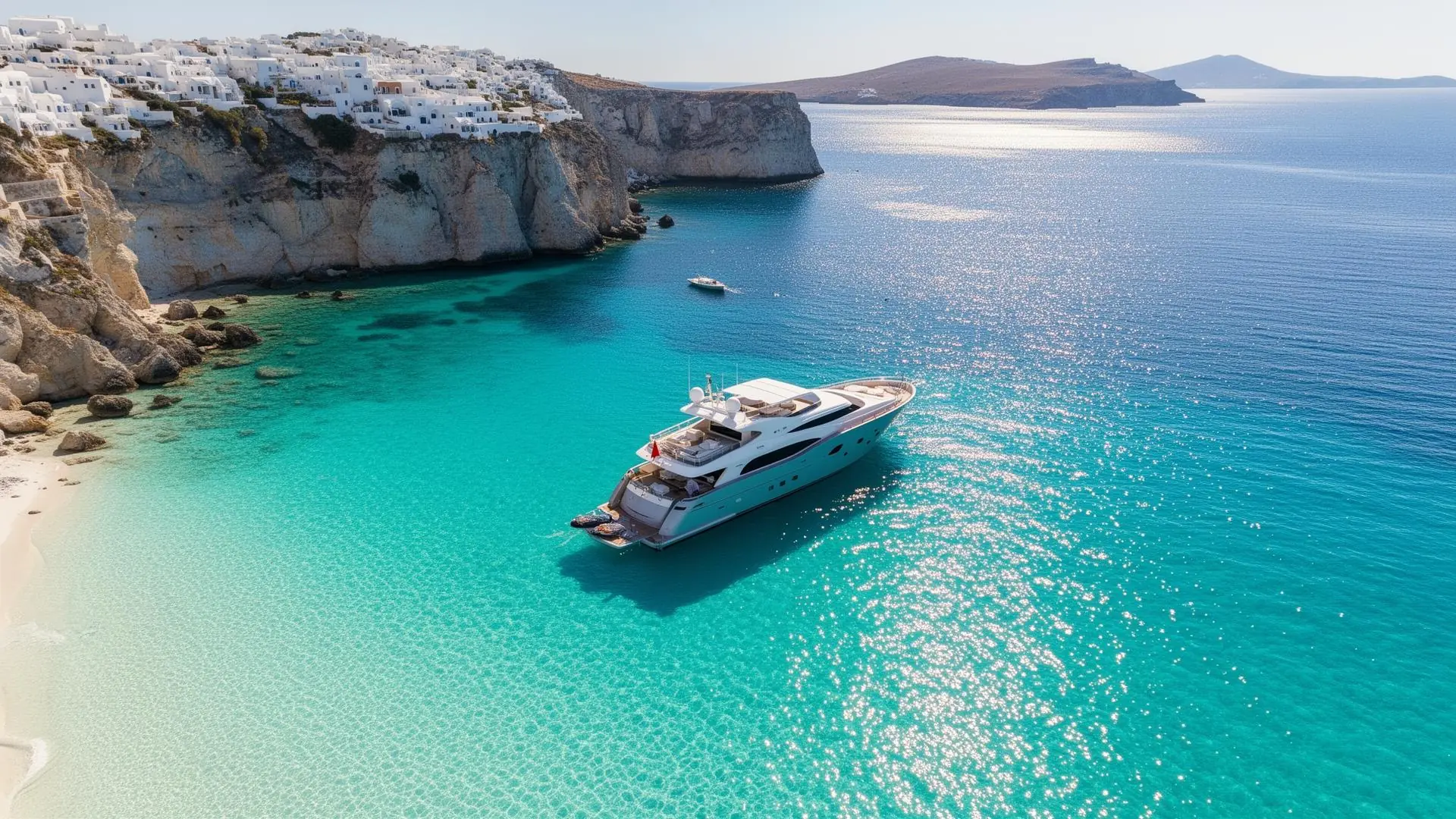
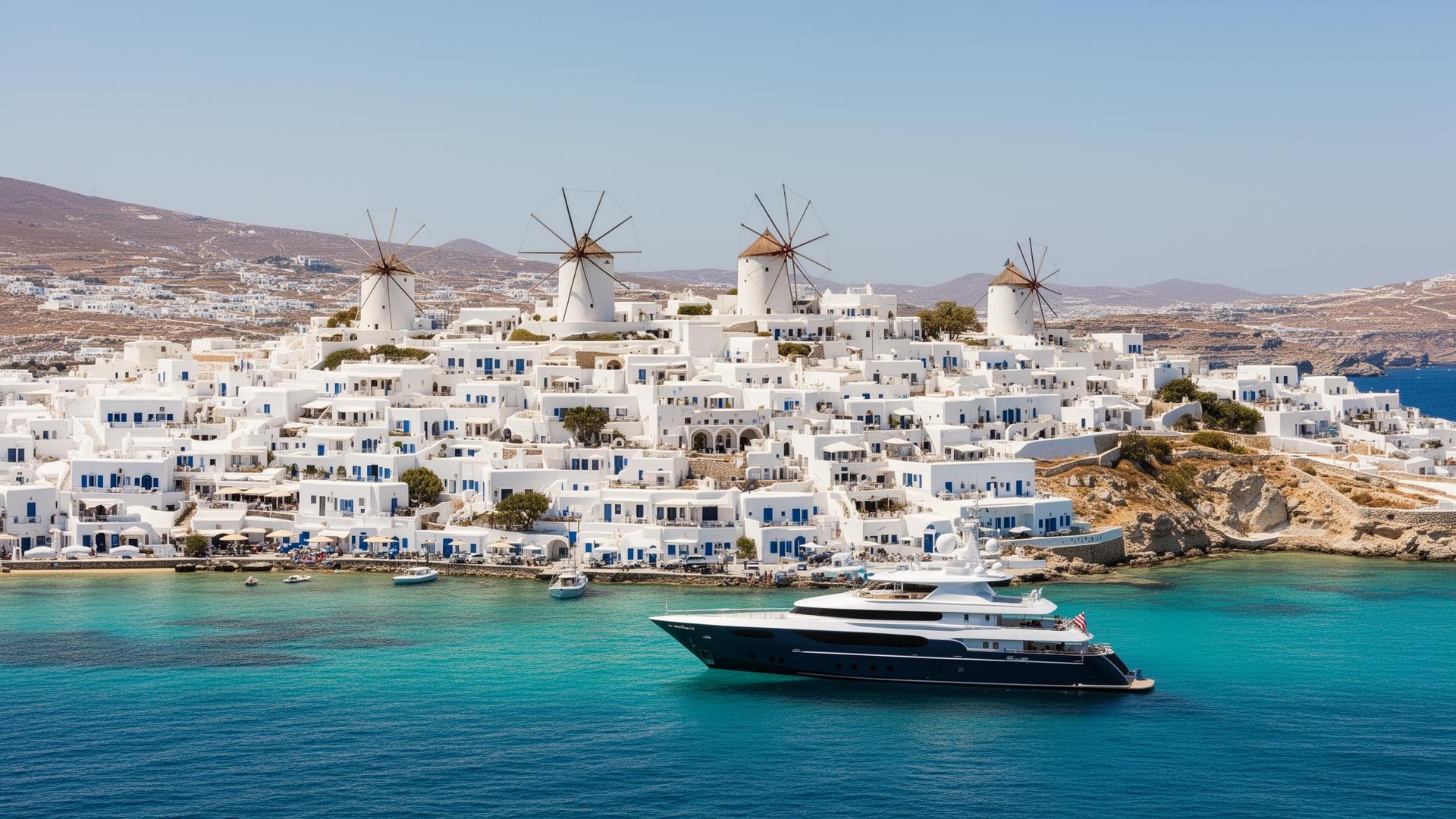
Santorini is the most photographed Mediterranean island and the most operationally difficult anchorage in the Aegean. The geology — a flooded caldera 12 kilometres across, 400 metres deep at the centre, formed by the 1600 BC Minoan eruption that displaced the equivalent of 60 cubic kilometres of rock and reshaped the entire Bronze-Age Aegean — is the entire visual product. White Cycladic villages on the rim of the caldera 300 metres above the water, the cliff dropping vertically to the sea, the volcanic islands of Nea Kameni and Palea Kameni still steaming in the centre. There is no other anchorage in Europe that looks like it.
There is also no harbour. The caldera is too deep for conventional anchoring (most boats hold on permanent mooring buoys laid by the Santorini Port Authority along the rim, or anchor on the shallow shelf at Vlychada on the south coast outside the caldera), the small commercial port at Athinios handles only the ferries and the day-boat cruise traffic, and the famous old harbour of Ammoudi below Oia is essentially a tender quay with no berthing for serious yachts. Almost every Santorini charter day is anchor-or-mooring-only, and the cliff exposure on the caldera side means that a single shift in wind direction — particularly a westerly that builds an uncomfortable chop — can render the overnight anchorage uncomfortable to dangerous within an hour.
This is why almost every experienced Cycladic captain treats Santorini as a daytime stop and an early-evening photograph, not as a sleep. The version that works overnights to the south at Vlychada, behind Thirassia on the western rim, or fifteen miles north in the lee of Ios.
The Caldera Programme
The Santorini day on a charter is well-defined and operationally tight. The pattern almost every captain follows:
- Late-morning arrival from the north, ideally from a Naxos or Ios anchorage. Mooring at the cliffside buoys below Imerovigli or Fira gives the photographic angle that is the entire visual point of the day.
- Tender or cable car ashore in the late morning to Fira town for the walk to Oia along the caldera rim — three hours one way through the most-photographed village street in the Cyclades.
- Lunch ashore in Oia at one of the cliffside terraces (Ambrosia, Kastro, Lauda at the Andronis hotel) or back on the boat in the caldera.
- Afternoon at anchor for the volcanic-island excursion. Nea Kameni's sulphur vents and the warm-spring swim off Palea Kameni are the standard half-day off-water programme. The two volcanic islands sit in the middle of the caldera; the boat anchors a short tender-run from the landing.
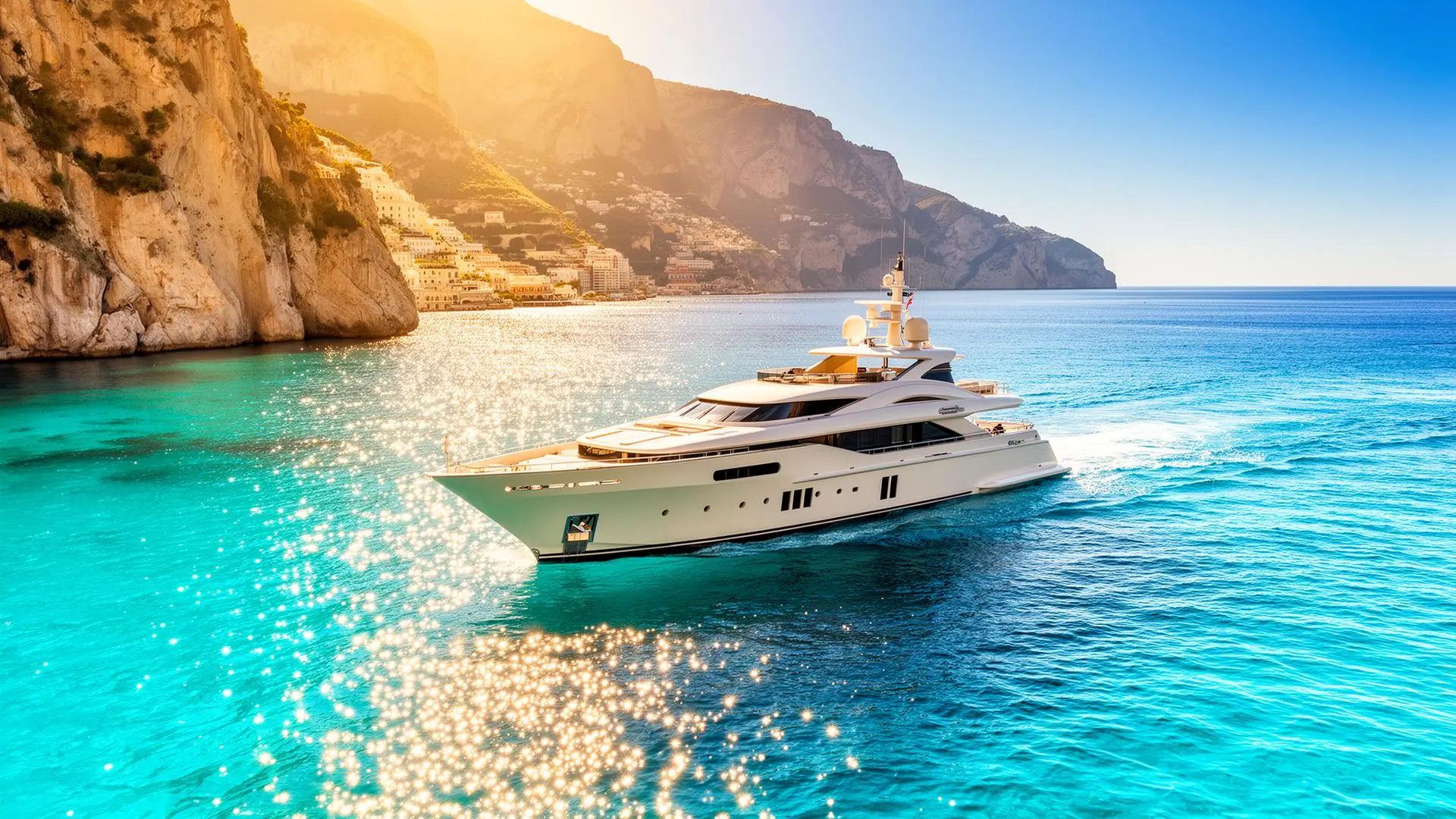
- Late afternoon and sunset back on the cliffside mooring. The Santorini sunset is the cultural high point of the day and is unambiguously better seen from the water than from the over-crowded sunset terraces in Oia. The boat positioned a hundred metres off the cliff at 19:30 in late July, looking up at the village in the gold hour, is the postcard that justifies the entire stop.
- Move overnight to Vlychada, behind Thirassia, or back north to Ios. The cliffside mooring is not a comfortable overnight in any direction the wind decides to clock to.
The Vlychada Alternative
Vlychada, on the south coast outside the caldera, is the working anchorage for any boat that needs to overnight in Santorini. Sheltered from the prevailing Meltemi by the bulk of the island, with a small marina that takes a limited number of larger yachts and a roadstead anchorage in workable depth. The trade-off is the visual: Vlychada is the lunar-landscape side of Santorini — black sand, volcanic cliffs, no white villages — and it does not deliver the postcard. As an overnight base for a charter that wants two days on the island (one for the caldera programme, one for the Akrotiri Bronze-Age site and the south-coast wineries), Vlychada works. As a substitute for the caldera mooring, it does not.
The Akrotiri Day
The genuinely under-used Santorini excursion is the Akrotiri archaeological site on the southwest tip of the island. Akrotiri was a major Minoan-era settlement preserved under volcanic ash by the same eruption that created the caldera — the closest analogy is Pompeii, except 1,700 years older. The current covered site walk includes the multi-storey Bronze Age buildings, the frescoes (the originals are mostly in Athens), and the drainage and pottery systems that demonstrate the sophistication of the pre-eruption Cycladic civilisation. A morning ashore at Akrotiri, with the boat anchored in the lee of the southwest peninsula, is the cultural depth that the standard Santorini day misses entirely.
The Santorini Wine Programme
Santorini is one of the most distinctive wine regions in the Mediterranean. The Assyrtiko grape, grown low in baskets directly on the volcanic soil to protect against the Aegean wind, produces a mineral-driven white that ages remarkably and pairs with the seafood programme on most yachts better than almost any other Mediterranean white. The wineries — Santo Wines on the caldera rim with the panoramic terrace, Domaine Sigalas in Oia, Argyros on the central plateau, Estate Hatzidakis south of Fira — are open to visitors and the half-day tasting programme is one of the better off-water exercises available on a Cycladic charter.
The Operational Realities
Mooring allocation. The cliffside buoys are allocated by the Santorini Port Authority. Allocation in peak season is tight; the slot is generally arranged through the agency in Fira and confirmed twenty-four to forty-eight hours before arrival. The boats that turn up without a pre-arranged buoy in August generally find no slot and have to anchor on the shallow shelf at Vlychada.
The wind. The Meltemi blows from the north and the caldera is partially sheltered by the topography, but a westerly shift (less common in summer but not rare) builds a swell into the caldera that can make the mooring untenable. A captain who watches the forecast at six-hour intervals and is willing to move the boat is the difference between a smooth Santorini stop and a wet one.
The cruise-ship calendar. Santorini receives more cruise-ship traffic than any other Greek island — five to seven ships in the caldera on a typical July day, each disgorging two to three thousand passengers into Fira and Oia. The morning until 11:00 and the late afternoon after 17:00 are the windows when the villages are walkable. Lunch ashore between 12:30 and 16:00 in the high cruise season is a queueing exercise.
Where Santorini Fits in a Cycladic Week
The honest place for Santorini in a one-week Cycladic charter is as a single 24-hour stop on the southern leg of the loop — arrive late morning from Ios or Folegandros, run the caldera day programme, take the sunset photograph from the mooring, move overnight back north to Ios or south to Anafi for the sleep. The week that gives Santorini two or three nights generally finds, by the second day, that there is no more daytime programme to fill and the photogenic value has been over-extracted.
Costs
Santorini does not have a separate charter base rate; the cost is incorporated into the broader Cycladic week. A 30-metre motor yacht on a Cycladic loop with a Santorini stop runs €70,000 to €120,000 per week base. The Santorini-specific overheads — the mooring fee, the agency clearance, the cruise-traffic-driven restaurant pricing in Oia — typically add €2,000 to €5,000 on a 24-hour stop. The Greek 12 percent VAT and 25 to 30 percent APA framework apply.
What Santorini Sells
Santorini is the most cinematic 24 hours available on any Mediterranean charter and the most over-stayed island in the Cyclades. The cliff, the caldera, the sunset, the volcanic walk to Nea Kameni, the Akrotiri archaeology, the Assyrtiko wine programme — all of it lands in a single well-paced day. The charter case for Santorini is the one-day stop, the sunset mooring, and the early-morning move to a quieter overnight anchorage. The charter case against Santorini as a multi-day base is the operational difficulty, the cruise-ship calendar, and the diminishing marginal return on the second day ashore. A well-built Cycladic week uses Santorini precisely. A first-time charter often does not, and discovers by the second morning that the most photographed cliff in the Mediterranean is also, after sunrise, just a cliff.