
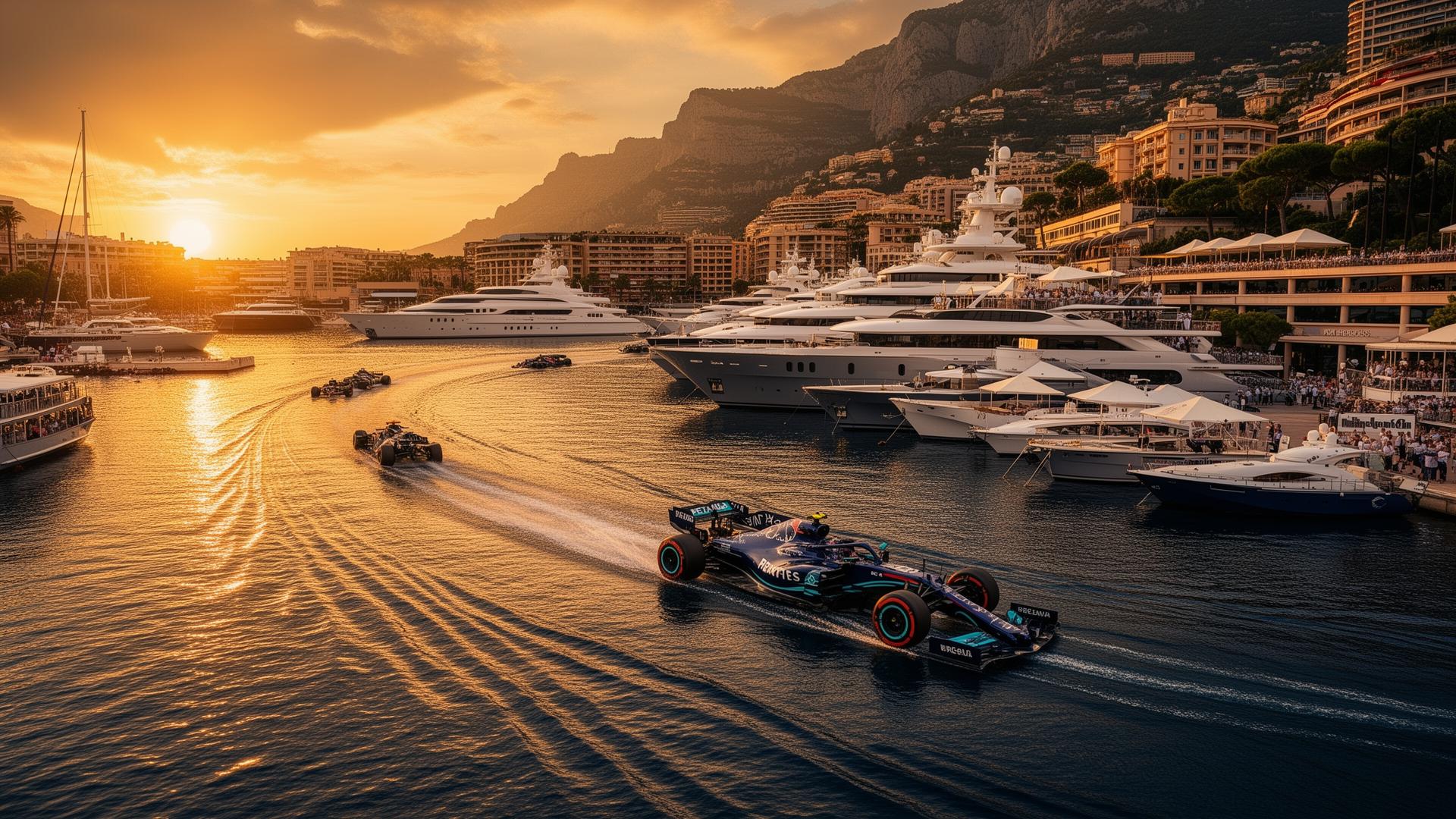
Monaco Grand Prix · Monaco, Monaco
Monaco Grand Prix Yacht Charter
The most concentrated week of wealth, sport and theatre on the calendar — written from the perspective of brokers who place yachts on the Quai Albert 1er every season.
Dates
4–6 June 2027
Location
Monaco, Monaco
Attendance
F1 principals, royalty, finance and tech UHNWIs, Hollywood, fashion houses
Charter from
€450,000 / week
Updated
2026-10-19
Check the edition-specific session programme, including Sprint sessions; yacht berths and race hospitality require separate confirmation.
Official organiser datesTickets · Mediterranean · Circuit de Monaco
Monaco Grand Prix tickets
The figure on each card is the published price. A yacht charter is requested separately.
General admission
GA Sector Rocher
From EUR 550
Sunday.
Grandstand
Grandstand
From EUR 1,495
Saturday–Sunday.
Hospitality
Harbour Club, 2nd floor Ermanno
From EUR 2,437
Saturday.
Yacht hospitality
Harbour Club 30 m and 50 m yacht hospitality
Price on request
Yacht hospitality
Yacht hospitality
Price on request
Yacht party
Friday night yacht party
From EUR 1,023
Friday. No race access.
Editor's introduction
Why Monaco Grand Prix belongs on the water.
Booking note
Monaco Grand Prix front-quay berths sell out 12–18 months in advance.
There is no harbour in the world where the gap between watching an event and inhabiting it collapses the way it does in Port Hercule during Grand Prix week. The Formula 1 circuit runs literally along the quay — drivers brake from 290 km/h roughly twenty metres from the swim platform of any yacht moored on the Quai Albert 1er. The cars are not on a screen at the end of a grandstand; they are in your peripheral vision while a guest is reaching for an espresso. That single fact is the reason a Monaco Grand Prix charter exists as a product category at all, and the reason demand for harbour berths is the most contested logistical problem in superyacht chartering.
What people who have never done it underestimate is that the racing is the smallest part of the week. A serious Monaco Grand Prix charter is a six- to eight-day social and commercial campaign: a Tuesday arrival to get guests settled and crews briefed; a Wednesday and Thursday of private lunches, marina walking, founder dinners and the Amber Lounge build-out; a Friday of practice that finishes early enough to host a 60-person aft-deck reception; a Saturday of qualifying that empties the harbour onto helicopters bound for Cannes or Saint-Tropez; and a Sunday of race-day brunch service from 09:00 that pivots into a wind-down dinner and Amber Lounge after-party. The yacht is the stage, the office, the hotel and the green room simultaneously, and the brief from most principals is some version of "make the operational complexity invisible to my guests."
The 2027 Monaco Grand Prix is scheduled for 4–6 June. A charter can include additional arrival and departure days, but these are not extra Formula 1 race days. Session times, support-series schedules and hospitality access must be confirmed for the specific edition; older Thursday-practice timetables should not be used to plan a current booking.
Editorially, we approach Monaco the way a hospitality team would approach a private wedding compounded with a corporate annual gathering. Every element — the berth, the chef, the tender movements, the helo windows, the table at La Petite Maison, the Amber Lounge wristbands, the paddock pass count, the FaceTime-quality WiFi for the deal call you cannot avoid — needs to be locked in months ahead and rehearsed by the crew before the first guest steps aboard. This guide is what we tell new clients about how the week actually unfolds.
The yacht advantage
A private address inside the week.
01
Prime viewing position
Front-row berths place you closer to Monaco Grand Prix than any hotel suite — and on a private deck rather than a packed grandstand.
02
Total privacy & security
A private floating residence with controlled access, no shared lobbies, no paparazzi sightlines, and dedicated close-protection partners on request.
03
VIP hospitality at scale
Host 8 overnight and 30+ day guests across event days. Branded welcome, bespoke menus, a chief stewardess who knows your guest list cold.
04
Michelin-level cuisine onboard
Yachts in this class carry chefs with starred backgrounds. Tasting menus, dietary tailoring, and live stations on the aft deck.
05
Concierge & event access
Tickets, paddock access, gala invitations, and after-party reservations handled by our concierge desk — the parts of the week not bookable online.
06
Helicopter & private aviation
Coordinated transfers between jet-capable airport, helipad, and tender pickup at the yacht's stern. No queues, no lost hours.
07
Zero logistics for guests
Guests arrive once and unpack once. No traffic, no hotel changeovers, no morning scramble for cars.
08
Bespoke post-event cruising
Slip the lines after the event and disappear into the surrounding coast for a private decompression week.
Indicative charter budgets
Choose the platform, not just the length.
Base charter only. Add APA typically 25–35%, VAT where applicable, gratuity and event-week berth or anchorage costs.
Entry
30–37m motor yacht
From €185,000
- Berth supplement
- €55–95k for race week
- Best for
- 6–8 sleeping guests, 20-guest daytime hosting
The most efficient Monaco Grand Prix charter — a modern thirty-something-metre tri-deck with a competent crew of six. You will not host a 60-person reception comfortably at this size, but you will sleep your principal party, run race-day brunch for twelve, and you will still be on the front quay if your broker has secured the right berth. Most of our smaller-group Monaco charters happen in this bracket.
Core
38–48m motor yacht
€280,000–€520,000
- Berth supplement
- €85–160k for race week
- Best for
- 10–12 sleeping guests, 40-guest aft-deck reception
The sweet spot of Monaco Grand Prix demand. A modern 42-metre Sanlorenzo, Benetti or Heesen with crew of eight, a chef with a starred CV, two main-deck staterooms and a full sun-deck Jacuzzi. Hosts a meaningful Friday-evening reception, sleeps the principal party and a key client pair, and clears the helicopter-pad weight limits for guest transfers in either direction.
Showpiece
49–60m motor yacht
€520,000–€950,000
- Berth supplement
- €160–290k for race week
- Best for
- 12 sleeping guests, 60–80-guest standing reception
The yacht as proper hospitality platform. Twelve guests across six or seven suites, crew of twelve to fourteen, a beach club aft, a sky lounge that converts to a private dining room for fourteen, a touch-and-go helipad on the larger units in this bracket. Most corporate Monaco charters that need to host an industry-defining reception sit here.
Statement
61–80m motor yacht
€950,000–€2.1m
- Berth supplement
- €290–550k for race week
- Best for
- 12 sleeping guests, 100+ guest reception, certified helideck
The yacht as a destination unto itself. Crew of eighteen to twenty-five, a certified helideck capable of receiving a Bell 429 or Airbus H145, full beach club with gym and spa, formal indoor dining for sixteen. This is the bracket where a serious corporate or family-office Monaco week starts to make full operational sense — every guest function happens on board, helicopter movements are choreographed in and out of the yacht itself, and the principal never needs to leave the platform for the full seven days unless they choose to.
Pinnacle
80m+ superyacht
€2.1m–€4.5m+
- Berth supplement
- €550k–€1.1m for race week
- Best for
- 12 sleeping guests, 150+ standing, full event production
A small, tightly-controlled tier — typically four to six yachts available globally that combine 80m-plus length, charter availability, and a willingness to come to Monaco for race week (many owners keep their own yacht in Port Hercule for personal use that week). Reserved for clients running a full branded activation, a celebrity-anchored after-party, or a hosted family gathering at scale.
French Riviera
Experience Formula 1 from the most exclusive vantage point on the French Riviera aboard a private superyacht in Port Hercules.
Event schedule
Monaco Grand Prix day by day.
Indicative running order based on prior editions. Organisers confirm final times closer to the date; your concierge verifies the working schedule for your charter week.
Tuesday · Race week –5
Soft arrival & rig
Crews arrive into Port Hercule typically on the prior Saturday. By Tuesday the harbour barrier is up, the pit-lane infrastructure is built, and the bulk of guest-facing yachts have completed their pre-charter provisioning runs from Antibes or Nice. Principals favour a Tuesday-evening arrival: helicopter from Nice Côte d'Azur to Monaco Heliport, a seven-minute Riva transfer to the yacht's stern, an informal sushi-led dinner on board to set the tone. Avoid scheduling external dinners on day one — guests are jet-lagged and the harbour is still in a setup posture.
Wednesday · Race week –4
Guest arrival & shore planning
Use a pre-race day for guest arrival, provisioning and any confirmed shore reservations. Do not assume support-series or historic-race sessions are part of this edition; check the organiser's programme before arranging track access.
Thursday · Race week –3
Pre-weekend preparation
Thursday is an optional charter preparation day, not a promised Formula 1 practice day. Confirm guest transfers, berth access, tender movements and hospitality bookings against the edition-specific programme.
Friday · Race week –2
Opening race-weekend day
Friday 4 June opens the scheduled 2027 race weekend. Confirm the official session timetable before arranging receptions, transfers or shore bookings; the yacht's berth and sightlines remain subject to its contracted position.
Saturday · Race week –1
Qualifying — the most decisive day
Saturday 5 June falls within the scheduled race weekend. Use the published organiser timetable for qualifying and support sessions when finalising meal service, shore visits and guest transfers; do not promise session times before confirmation.
Sunday · Race day
Race-day brunch, lights out & podium
Sunday 6 June closes the scheduled 2027 weekend. Arrange race-day hospitality and departures around the official programme once released. Visibility from the yacht depends on the specific berth; track access and hospitality tickets are separate arrangements.
Monday · Race week +1
Recovery & post-event cruising
Helicopter departures from Monaco Heliport peak between 07:00 and 11:00 Monday morning. Yachts that wish to remain in Monaco for the post-race quiet day pay the same berth night as Sunday — most slip lines by mid-morning and cruise west toward Saint-Tropez, Cannes, or south toward Bonifacio for a private decompression week. This is the single best moment of the year to cruise the Côte d'Azur: weather is set, marinas are emptying out, and you have the coast roughly to yourself for forty-eight hours before the early-June repositioning fleet arrives.
Event highlights
The moments that define the week.
Circuit de Monaco
The only street circuit in modern F1. 3.337km, 78 laps — and the harbour is in every broadcast shot.
Port Hercules front-quay berthing
Front-quay positions on Quai Antoine I and Quai des États-Unis. We secure them at contracting.
Paddock Club & paddock access
Paddock Club hospitality, garage tours, and grid walks through our F1 partnerships.
Amber Lounge & Y.CO
The official after-party calendar — typically by invitation, regularly arranged for our charter guests.
Helicopter from Nice
7-minute helicopter transfer from Nice Côte d'Azur to Monaco Heliport.
Post-race Riviera cruise
Saint-Tropez, Portofino, or the Îles d'Hyères for private decompression.
Where the week happens
Berths, terraces and tables.
Berth
Quai Albert 1er — front-row berths
The single most coveted moorings on earth for one week a year. Yachts berthed here have the track in their hospitality view, look directly across to the Princely Palace, and are roughly a thirty-second walk from the paddock entrance. Allocation is controlled by Monaco Ports Authority and effectively closed by January for the relevant race edition.
Berth
Quai Antoine 1er — Amber Lounge side
The opposite quay, with the Amber Lounge tent installation directly behind the moorings. Slightly less expensive than Albert 1er, slightly better positioned for late-night Amber Lounge access, slightly less iconic for the on-track view. The pragmatic broker's pick when Albert 1er is gone.
After-party
Amber Lounge — Le Méridien
The definitive post-race venue since 2003, run by Sonia Irvine. Thursday, Friday and Sunday programming — Fashion Monaco on Friday is the marquee night. Wristbands are not for sale at the door; they are allocated to teams, sponsors and a small number of trusted hospitality partners. Plan minimum eight weeks ahead.
Nightclub
Jimmy'z Monte-Carlo
The Société des Bains de Mer institution that anchors Monaco nightlife year-round. During Grand Prix week the door is heavily controlled and the table minimums multiply. The garden in the Sporting d'Été complex is the more atmospheric room than the indoor club for an after-dinner segue.
Restaurant & terrace
Twiga Monte-Carlo
Flavio Briatore's restaurant-club on the Quai Albert 1er with a terrace that looks directly onto the harbour and the track exit. Long lunches segue into evening service and an after-midnight DJ programme. Walk-up impossible during race week — table held minimums in the five-figure range.
Restaurant
La Petite Maison de Nicole — Hôtel de Paris
The Monégasque outpost of the legendary Niçoise restaurant. The single most contested Saturday-night dinner reservation in the principality during Grand Prix week. Eight to ten weeks of lead time, ideally booked the moment your charter is contracted.
Restaurant
COYA Monte-Carlo — Hôtel de Paris
Peruvian-Japanese, opened 2022, and now the harder reservation than COYA Mayfair during race week. The terrace overlooking Casino Square is the room to ask for. Pairs naturally with a late drink at the American Bar across the lobby.
Restaurant & lounge
Buddha-Bar Monte-Carlo
Inside the Casino de Monte-Carlo on Place du Casino. Pan-Asian with a dramatic interior; the more theatrical alternative to COYA on a Saturday night. The lounge mezzanine becomes a serious room from 23:30.
Late-night restaurant
Sass Café
Avenue Princesse Grace, no view of the harbour, but the post-Jimmy'z room for the Monaco regulars from 01:00 onward. Live music, raised tables, an unapologetically expensive bottle list. A useful Saturday-night closer when guests still have energy.
Club
Yacht Club de Monaco
Norman Foster building on Quai Louis II, opened 2014, members-only. If your charter includes an introduction from an existing member — which our concierge desk can arrange in a percentage of cases — the rooftop terrace is the calmest harbour-view room in Monaco during the chaos of race week.
Helo lounge
Buddha Bar Heliport
Monaco Heliport's pop-up lounge during race week — the staging area for guests waiting on Cannes / Nice / Saint-Tropez departures. Useful to know the staff personally if you have time-sensitive Sunday-evening departures.
Restaurant
Cipriani Monte-Carlo — Place du Casino
Recent addition (2023) to the Casino Square line-up. Italian, the predictable kitchen quality of the Cipriani family, the calmest of the contested Saturday-night rooms in our experience — useful when you cannot land La Petite Maison.
Sample week
A yacht itinerary around Monaco Grand Prix.
Day 1 — Sat
Cannes board, soft cruise to Cap d'Antibes
Board in Cannes mid-afternoon — easier helicopter and airport logistics than embarking directly in Monaco, and avoids the harbour chaos on event-week Saturday. A two-hour cruise across the Baie de Cannes to anchor off the Hôtel du Cap-Eden-Roc. First-night dinner on board: amuse, raw fish, a light main, an early bedtime.
Day 2 — Sun
Antibes to Monaco repositioning
Early-morning cruise east past Nice, around Cap Ferrat, into Port Hercule by mid-morning. Lock into the contracted berth. Walking lunch through Monte-Carlo and the Casino Square. An early dinner on board to absorb the harbour atmosphere before the week accelerates.
Day 3 — Mon
Monaco — paddock & city day
Monte-Carlo Country Club for a coffee or a tennis hit. Walking circuit of the track on foot — Sainte Dévote, Beau Rivage, Massenet, the Casino, the Mirabeau, the Loews hairpin, Portier, the tunnel, the chicane, Tabac, the swimming pool, La Rascasse. Paddock walk if accreditation is in hand. Dinner at Em Sherif Monte-Carlo.
Day 4 — Tue
Bouldering up the coast — Èze, Villefranche, Saint-Jean-Cap-Ferrat
Take advantage of being already in Monaco to do the half-day cruise that visiting yachts never have time for — anchor off Villefranche-sur-Mer for lunch at La Mère Germaine, swim off the platform in the afternoon. Return to Monaco for early evening. Quiet dinner on board.
Day 5 — Wed
Founder lunch on board, evening at the harbour
Hosted lunch on the aft deck for twelve — partners, advisors, family-office contacts. The first day the harbour is properly populated and yacht-hopping begins. Soft brokerage walk-throughs through the late afternoon. Dinner at Twiga or COYA Monte-Carlo.
Day 6 — Thu
Final preparation before race weekend
Confirm guest movements, provisions and berth access. Thursday is not a promised Formula 1 practice day; reserve hospitality only against the edition-specific programme.
Day 7 — Fri
Reception day, then Saint-Tropez disembark
Either: stay for qualifying Saturday and race Sunday on the front-quay berth and continue the editorial that follows; or, for a one-week itinerary that respects guests' schedules, host the marquee 60-guest aft-deck reception 17:00–20:30 Friday evening, helicopter departures Saturday morning, yacht slips lines and cruises west to Saint-Tropez for the Sunday-evening disembark — race watched from the comfort of a Pampelonne lunch.
Guest experience
What life on board looks like.
The defining feature of a Monaco Grand Prix charter is the controlled overload. Guests are choosing it precisely because they want to be in the middle of everything; the broker's job is to make the middle of everything feel calm. That means a chief stewardess who knows every guest's allergies, drink order and connection-time tolerances before they arrive; a chef who can pivot from a 32-cover sit-down to a 60-cover canapé reception in the same afternoon; a captain who has run Monaco at least three seasons and knows the harbour master's mobile number; and a concierge layer above all of that handling tables, wristbands, helicopters, paddock passes and the dozen small favours that materialise at 22:00 on Friday night.
On board, the small details are the ones that matter. A separately stocked non-alcoholic bar — race-day brunch runs from 09:30 to 14:30, and most guests are pacing themselves. A press-grade WiFi backbone with Starlink and a redundant 5G failover — every charter we run has at least one principal taking a board call from a stateroom on race-day morning. Branded crew uniforms if the week is a corporate activation. A dedicated guest-relations officer separate from the chief stew if you are hosting more than thirty external guests over the week. A tender programme that can move twelve guests at a time between yacht and quay without anyone waiting more than four minutes — Monaco's quays are constrained and guests develop short fuses about tender queues.
Off the yacht, the most useful single thing we provide is what we call a master schedule — a printed and digital living document, updated nightly by the concierge desk, that captures every guest's confirmed reservations, helicopter slots, paddock windows, after-party wristbands and morning wake-up calls across the seven days. It is the artifact that lets a principal stop thinking about logistics and simply enjoy their week, and it is the artifact that separates a serious Monaco Grand Prix charter operation from one that is improvising.
Booking timeline
How Monaco Grand Prix actually gets booked.
T–14 to T–18 months
Yacht longlist & berth strategy
Serious Monaco GP enquiries land with us by January or February of the year before the race. We open with a longlist of twelve to twenty yachts that meet your group brief, in parallel with a frank conversation about which quays are realistically available — Albert 1er front-row inventory tends to be locked by November of the prior year, and the conversation about second-best alternatives has to happen early.
T–10 to T–12 months
Yacht shortlist & contract
Three or four finalist yachts, ideally one inspection trip (often during the Cannes Yachting Festival in September or the Monaco Yacht Show itself), then a contracted yacht with a signed charter agreement and 50% deposit. The deposit secures the yacht; the berth is a separate contract negotiated by us in parallel.
T–6 months
Berth confirmation & guest list lock
Berth contract confirmed and second deposit instalment paid. Provisional guest list locked at 60–70% certainty — Monaco helicopter logistics need to be modelled against headcount, and Amber Lounge / paddock allocations need to be requested at this point.
T–3 months
Concierge build & supplier coordination
Restaurant reservations confirmed for the full week. Helicopter slots booked with Monacair / Heli Air Monaco. Amber Lounge wristbands allocated. Paddock pass count finalised with the team or hospitality partner. Branded provisioning ordered. Pre-arrival guest communications drafted.
T–6 weeks
Final guest list & dietary lock
Confirmed guest list with passports, dietary needs, allergies, arrival flights and connecting helicopter manifests handed to the chief stewardess and the chef. Yacht crew briefing day held remotely or in person.
Race week
Live concierge layer
On-site concierge from Tuesday through Monday morning, present in the harbour, on call to guests via WhatsApp, holding the master schedule, troubleshooting in real time. This is the layer that most clients only realise they needed after they have done a Monaco week without it.
Where the fleet lies for Monaco Grand Prix
Questions answered
Monaco Grand Prix charter, in detail.
How much does a Monaco Grand Prix yacht charter actually cost, all-in?
A realistic all-in budget for a 40-metre yacht on the Quai Albert 1er for the seven-night charter week runs €550,000–€820,000. That comprises a base charter fee of roughly €310,000–€450,000, an APA of 30–35% covering fuel, food, beverages and ports, the race-week berth supplement of €85,000–€160,000, and event-specific concierge, helicopter, paddock and Amber Lounge spend that typically adds €40,000–€90,000. Smaller yachts (30–37m) start from around €350,000 all-in; 50m-plus yachts move the all-in budget above €1.1m.
When do I need to book a Monaco Grand Prix charter for next year's race?
For front-quay berths (Quai Albert 1er and the prime Quai Antoine 1er positions), the practical booking deadline is twelve to fifteen months ahead of race day. By January of the race year, the harbour is effectively allocated. Yachts in the 30–40m bracket without a front-quay berth requirement can sometimes be contracted as late as January or February — but you will be moored at one of the back quays or anchored off, and that is a fundamentally different experience.
Is the berth in Port Hercule included in the charter price?
No, and this is the single most important pricing point to understand. The berth is a separate contract with Monaco Ports Authority (Société d'Exploitation des Ports de Monaco) or with a private berth-holder. Race-week berth fees range from roughly €55,000 for a back-quay 35m mooring to €1m-plus for prime front-quay 80m positions. We negotiate and contract the berth in parallel with the yacht; losing the berth nullifies the purpose of the charter, so the two contracts are managed as one.
Can I see the F1 cars from the yacht, or do I still need paddock tickets?
Yachts on the Quai Albert 1er have a direct, unobstructed line of sight to the track between roughly the Nouvelle Chicane and the swimming pool section — you see the cars exit the tunnel, brake into the chicane, and accelerate past Tabac. From a Quai Antoine 1er berth you see them along the harbour-front straight and the swimming pool. Most guests still want at least a half-day paddock visit for the experience; we arrange paddock and team-hospitality access through partner relationships, separately from the yacht and berth.
How many guests can I host on board versus how many can sleep?
Charter regulations limit overnight guests to twelve. Daytime hosting numbers depend on the yacht: a 42m typically supports a 40-guest standing aft-deck reception comfortably, a 55m supports 70–80, an 80m supports 120-plus. We model the headcount against the chief stewardess's service capacity and the heads (bathrooms) available — running a 70-guest reception with only two guest heads becomes unpleasant by hour two.
Can I land a helicopter on the yacht?
Only on yachts with a certified helideck — that effectively starts at 65–70m and is not universal even then. Most Monaco Grand Prix charters use the Monaco Heliport on the Fontvieille side, with a five-minute tender from the yacht's stern to the heliport pontoon. Touch-and-go helipads on smaller yachts are useful for departure-only operations but cannot receive a landing — the distinction matters for guest planning.
Should we board in Monaco or somewhere else?
We almost always recommend boarding in Cannes or Antibes and cruising into Monaco the day before the race week begins. Cannes has easier helicopter and airport logistics, no harbour-week security overlay, and gives the crew a calm half-day to receive guests and complete a soft welcome before the principal arrives into the intensity of Port Hercule. Disembarking can be done either in Monaco on Monday morning, or by repositioning to Saint-Tropez or Cannes on Sunday night for a Monday departure.
What is Amber Lounge and how do we get in?
Amber Lounge is the official post-race party series of the Monaco Grand Prix, founded by Sonia Irvine in 2003. It runs Thursday, Friday and Sunday evenings during race week, with Fashion Monaco on Friday as the marquee night. Wristbands are not sold publicly — they are allocated to F1 teams, sponsors, and a small number of trusted hospitality partners. We secure Amber Lounge access for our charter clients as part of the concierge package; the request needs to be in by February of the race year for guaranteed allocation.
How early do the guests really need to arrive?
We recommend Tuesday-evening arrival into Nice, helicopter to Monaco, dinner on board. A Wednesday arrival works but compresses the week — guests skip the soft acclimatisation day. Race-day-only arrivals are operationally possible but waste 80% of what the charter is for; if guests can only attend Sunday, a yacht-based experience is not the right vehicle for them and we will say so.
What is the realistic weather and what should guests pack?
The 2027 event is scheduled for 4–6 June. Check the forecast close to travel; pack a layer for cooler evenings and rain protection as well as any clothing required by your confirmed hospitality venues.
Is the WiFi on board good enough to take board calls?
On any modern yacht of any quality, yes. We require — and verify — Starlink Maritime as the primary backbone, a redundant 5G failover from a French SIM, and a guest-network capacity sized for at least 40 concurrent connections. Race-day mornings see at least one principal on every yacht in Port Hercule taking a board or family-office call from a stateroom; the bandwidth is non-negotiable.
Can I bring my own private chef or supplement the yacht's chef?
Yes, and on charters above 50m it is increasingly common for clients to bring a guest chef for a single specific dinner — typically the Saturday-evening private dinner for the principal's closest table. The yacht's permanent chef leads the rest of the week. We coordinate the kitchen access, the produce sourcing, and the service team so the handover is invisible to guests.
What about security, and is close protection necessary?
Port Hercule is a controlled environment during race week — pedestrian access to the quays is wristband-only, harbour patrol is significantly enhanced, and the yacht's own gangway protocol controls boarding. For high-profile principals we coordinate additional close-protection cover discretely; that conversation happens privately with the client's existing security director, not as a default add-on, and we have trusted partners in Monaco for principals who do not travel with their own team.
Can children and family groups attend, or is this an adults-only event?
Children are welcome and a number of family charters run during Grand Prix week — particularly families introducing teenage children to the sport. The yacht's chief stewardess can arrange a discreet children's programme on race day if guardians want to attend the paddock or a hospitality function. The principal logistical caution is helicopter weight allowances when moving children and luggage on tight Sunday-evening departure windows; we plan for it.
What is the cancellation and weather policy?
Charter contracts and berth contracts are separately covered. Yacht charter cancellation policies are governed by the MYBA or industry-standard agreement signed; typical structure is 50% deposit on contract, 50% balance at six months out, with the deposit non-refundable inside ninety days. Berth contracts in Monaco are generally non-refundable from the moment of allocation. We strongly recommend a tailored charter insurance policy that covers both the yacht and the berth — we can introduce a specialist broker for it.
Editor's note
Monaco Grand Prix is the one week of the year where a yacht is not the luxury option — it is the only operationally sensible option for a serious group. Booked correctly, it is the most concentrated and most memorable week we run for clients. Booked late, with the wrong berth, it is an expensive lesson. We open enquiries for the next confirmed race edition.
Private enquiry
Secure your yacht for Monaco Grand Prix.
Share the essential parameters. A fleet specialist replies with a live, commercially clear shortlist.
Live central-agent availability
Transparent all-in cost framework — base, APA 25–35%, VAT, berth, gratuity
Aviation, transfers and event-week concierge
Related events
Other events in French Riviera.
Plan your Monaco Grand Prix charter
Destinations → Yachts → Experiences → Events → Costs — every step of the brief, in the order our brokers work through it.
Around Monaco Grand Prix — destinations, marinas & reading
Continue with the destinations, itineraries, marinas and practical guides that are most closely related to this page.