
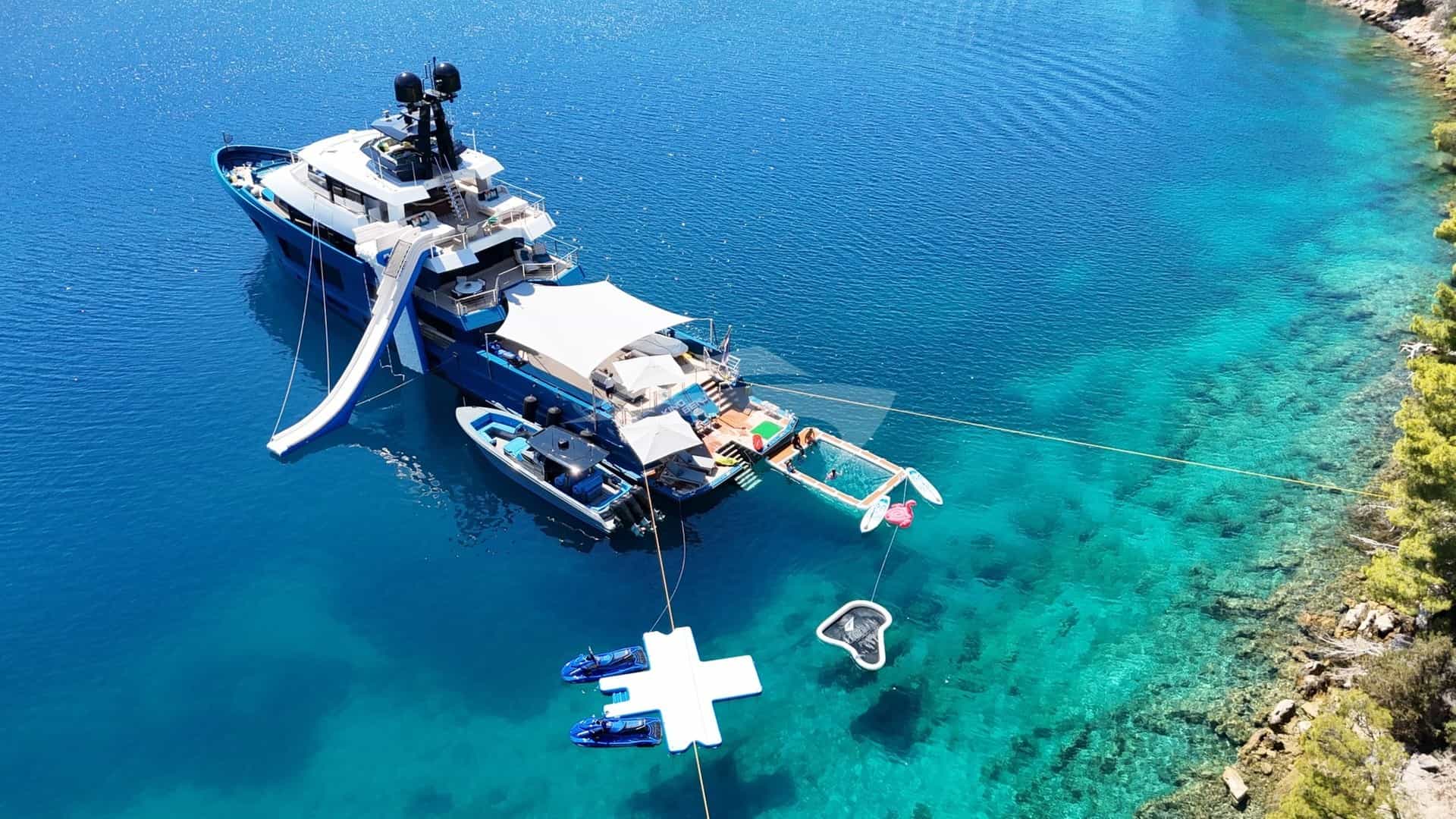
Base charter fee benchmarks for 2026
The base charter fee represents the hire of the yacht, the crew, and the insurance. It does not include food, fuel, or berthing. For 2026, pricing has stabilised following high post-pandemic inflation, but shipyard delivery delays for new hulls continue to keep demand high for well-maintained vessels built between 2018 and 2024.
Pricing varies by region due to local tax laws and the concentration of berth availability. The French Riviera remains the most expensive theatre of operation, followed by the Amalfi Coast. Croatia and Greece offer slightly better value on the base rate, though Greek VAT is notoriously fluid. In the Caribbean, the British Virgin Islands and St Barths command the highest premiums during the winter season (December to March).
The following table provides realistic base fee expectations for a one-week charter in high season (July/August in the Mediterranean; Christmas/New Year in the Caribbean).
| Yacht Size | Croatia (EUR) | Greece (EUR) | French Riviera (EUR) | Caribbean (USD/EUR) |
|---|---|---|---|---|
| 20m (Power Cat) | 35,000 – 50,000 | 38,000 – 55,000 | 45,000 – 65,000 | 40,000 – 60,000 |
| 30m (Motor Yacht) | 85,000 – 110,000 | 90,000 – 125,000 | 110,000 – 145,000 | 95,000 – 130,000 |
| 40m (Superyacht) | 160,000 – 220,000 | 175,000 – 240,000 | 200,000 – 280,000 | 180,000 – 250,000 |
| 50m+ (Mega Yacht) | 350,000+ | 380,000+ | 450,000+ | 400,000+ |
The Advance Provisioning Allowance (APA)
The Advance Provisioning Allowance is the most significant variable in yachting finance. It is an escrow fund, typically 30% to 40% of the base charter fee, paid in advance to cover the operating costs of your specific trip. The captain manages this fund and must provide a detailed breakdown of every receipt at the end of the charter.
The APA covers four primary categories: * Fuel (for the main engines, generators, and water toys). * Food and beverages (tailored to your preference sheet). * Mooring fees and port taxes. * Communication costs and bespoke delivery requests.
In 2026, fuel remains the most volatile component. A 40m motor yacht cruising at 14 knots will consume roughly 450 to 600 litres of diesel per hour. At a projected price of 1.90 EUR per litre, a four-hour transit between Mykonos and Santorini costs approximately 4,000 EUR in fuel alone. If you choose to remain at anchor rather than docking in expensive marinas like Ibiza Magna or Port de Cannes—where a 40m berth can cost 3,500 EUR per night in peak season—your APA will stretch significantly further. Any unspent APA is returned to you in cash or via bank transfer on the final day. Conversely, if the fund runs low due to heavy cruising or expensive vintage wine requests, you are required to top it up in cash immediately.
Crew gratuity and service standards
Unlike the hospitality industry on land, crew gratuity is a standard expectation in the yachting sector, reflecting the 24-hour service provided by a team that often doubles as navigators, chefs, engineers, and watersports instructors. The Mediterranean Yacht Brokers Association (MYBA) guidelines suggest a tip between 10% and 15% of the base charter fee. In the United States and the Caribbean, this often leans towards 15% to 20%.
The tip is always paid to the Captain, who distributes it equally among the crew. It is considered poor etiquette to tip individual crew members privately, as the engineers and deckhands working below deck contribute as much to the safety and smoothness of the voyage as the stews serving drinks. For a 100,000 EUR charter, a 12,000 EUR tip is the standard benchmark for excellent service. This should be factored into your initial budget alongside the APA.
Hidden line items and statutory costs
The most frequently overlooked cost is Value Added Tax (VAT). In 2026, European VAT rates for yacht charters remain complex. France and Italy generally apply 22%, while Greece fluctuates between 13% and 24% depending on the vessel's commercial licence and the itinerary's distance from the mainland. Croatia typically sits at 13%. Crucially, VAT is almost never included in the advertised "base price" and is calculated on the total charter fee.
Other "hidden" costs to monitor include: Delivery Fees:* If you request to start or end your charter in a location other than the yacht's home port, you will pay for the fuel and crew time required to move the vessel. For example, moving a yacht from Nice to Bonifacio for a charter start can add 5,000 EUR to 10,000 EUR to the bill. Airtel and Satcom:* While most yachts offer Starlink as standard in 2026, some older vessels still charge for high-bandwidth satellite data. Security Deposits:* Required for charters involving large events, high-risk pets, or specific high-value itineraries. Specialised Instruction:* If you require a licensed jet-ski instructor or a specialist dive master to join the crew, their day rate (usually 300 to 500 EUR) is billed to the APA.
When to book and the reality of last-minute deals
For the 2026 season, the booking window has lengthened. High-demand yachts—specifically those with "Chase Boats" or renowned chefs—are being secured 10 to 12 months in advance. Booking early (between August and November 2025 for the 2026 summer season) provides the widest selection and allows for "Early Bird" discounts, which typically sit at 5% to 10%.
The "last-minute deal" is a persistent myth that requires context. You will not find a 50% discount on a top-tier yacht in July. However, if a yacht has a "gap" in its calendar (for example, a 9-day opening between two 7-day bookings), the owner may offer a "gap filler" discount of 15% to 20% to cover the running costs. These deals usually appear 30 days before the start date.
The compromise is choice. If you book last minute, you must be flexible with the boarding port and the yacht’s layout. If you require a specific cabin configuration for four couples, booking less than six months in advance is high-risk.
Frequently Asked Questions
Does the price change if we have fewer guests? No. The charter fee is for the hire of the vessel, not per head. The only cost that decreases with fewer guests is the APA, as the food and beverage requirements will be lower.
Can I pay for everything in one go? The base fee and VAT must be paid in advance (usually 50% at signing and 50% five weeks before departure). The APA is also paid five weeks before departure. The tip is usually paid at the end of the week.
What happens if the weather prevents us from sailing? Yacht contracts (MYBA) state that if the vessel is technically capable of sailing but the weather is poor, no refund is due. If the yacht suffers a mechanical failure that lasts for more than 48 hours, you are usually entitled to a pro-rata refund of the base fee.
Are there extra costs for children? There is no "child rate" for the charter fee. However, some yachts require an extra stewardess to be hired if there are many young children, which would be an additional cost.
Is insurance included? The yacht’s hull and P&I insurance are included. However, Charterer’s Liability Insurance and Cancellation Insurance are highly recommended. Cancellation insurance typically costs 2% to 4% of the total charter value and protects your funds if you have to withdraw for medical or professional reasons.